WG PREVENTS A UNIVERSITY STUDENT FROM FIELDING FOR AUSTRALIA

WG PREVENTS A UNIVERSITY STUDENT FROM FIELDING FOR AUSTRALIA

On Tuesday  2 February 1892, a 24 year old university student waited to be called on to the ground to field as a substitute for the Australian cricket team.

It was late in the afternoon of the fourth day of the 2nd Test Match between Australia and England at Sydney's 'Association Ground' (now known as the Sydney Cricket Ground).

The young undergraduate was obliged, however, to wait while the Australian captain, Jack Blackham, tried to convince the English captain, the redoubtable WG Grace ('WG'), that Hutton was needed.

WG was in a foul mood. He had allowed controversy to swirl around him even before the team had left England and then throughout an ill-tempered tour. Now, the Australians' request to take the field with yet another substitute fielder was, in WG's mind,  like piling Pelion on Ossa. Things had not been going well either for WG or his English team ('Lord Sheffield's XI') which, earlier in the tour, Grace had claimed to be "the best team that had ever left England." Blackham's  request was stretching the limits of WG's forbearance.

Multiple Substitutes

Why did the Australians need a substitute fielder?

Well, actually, they needed two substitutes!

Firstly, NSW's captain, left hander Harry Moses, had unwisely begun the Test Match for Australia. He had wrenched his knee attempting a quick run during the 1st Test in Melbourne only three weeks previously. It became obvious during the Sydney Test that running between wickets and fielding were almost beyond him. In the 1st innings, Moses had made a laboured 29. WG, however, refused him a runner. WG was in no mood to be generous. He pointed out that he, a doctor, had advised Moses not to play and now he was unwilling to allow a substitute to field for him. Blackham persevered and WG eventually relented. Blackham nominated Syd Gregory, a fine fielder, who was 12th man for this Test. WG dug his heels in and refused the request for Gregory. Blackham then nominated the Test veteran, 33 year old Tom Garrett who was in Sydney, probably watching the game. WG finally agreed.

But now came another Australian request.

A telegram from Melbourne had arrived on Tuesday morning. It was addressed to Australia's all-rounder, Bob McLeod, and it contained distressing news. Bob's eldest brother, Norman, had died of complications from pneumonia at his home in Melbourne on Monday evening. Bob McLeod asked permission to leave Sydney late on Tuesday afternoon, after he had batted in Australia's 2nd innings, to be with his family in Melbourne. When he came in to bat, the crowd of 12,500 fell completely silent and then lustily cheered every run of his rather reckless 18. He was caught just before the afternoon tea break and dashed to catch the 5pm Melbourne train.

Australia's hard-fought 2nd innings, when the seemingly immovable Alick Bannerman took 448 minutes for his 91, concluded late in the day with a hattrick to Johnny Briggs but without Moses batting. England now needed 229 to win, having been 163 ahead on the 1st innings. The game was slipping away from Grace's grasp.

Australia, however, was lacking Moses, injured, and McLeod, by this stage on the Melbourne train. Garrett was already on the field. Gregory had earlier been refused permission to act as a substitute while the Australians wore black armbands out of respect for McLeod's family.

Blackham had another idea.

A young Melbourne University player was in the crowd. He had played his first game for Victoria at the Association Ground the week before the Test. And he had earlier played in the Intervarsity match against Sydney University during which he'd dominated the game, scoring  68 and taking 6 wickets.

His name was Ernest Hamilton Hutton.

Blackham approached WG.

WG: "Is he a better fielder than McLeod?"

Blackham: "Yes."

WG: "Then get someone else."

So, Hutton walked back to take a seat in the grandstand. Harry Donnan, who had been dropped from the 1st Test side after two failures when he scored 9 and 2, was summoned. WG, with more pressing things on his mind as he was to open the batting in England's quest for victory, this time agreed and Donnan fielded.

Australia was reduced to two main bowlers, George Giffen and Charlie Turner, but they took a wicket apiece, including Bobby Abel who had carried his bat for 132 in the 1st innings, the first instance of this in Test cricket. England struggled in gloomy conditions until Turner induced a thin edge to Blackham from WG and England went to stumps at a disastrous 3 for 11. On the next day, Australia won convincingly by 72 runs and the "best team that had ever left England" was 2-0 down in the three match series.

 Who was Ernest Hamilton Hutton?

Hutton had been born at Mount Rouse, west of Melbourne, on 29 March 1867, the second of three sons (William Joseph was born in 1866 and George Gerald in 1869) to William George Hutton (1835-1869) and Elizabeth Ann Whitehead who had been married in 1864.  William George's family, originally from Scotland,  owned extensive properties around Mount Rouse and important pastoral and merchantile investments. William George Hutton died when Ernest was an infant and his mother, with three young sons, moved to Ipswich in Queensland  where Ernest was enrolled at Ipswich Grammar School from the early 1880s. There he was an outstanding sportsman, participating in Victorian Rules Football, Rugby football, track and field, pole vaulting and hurdles, tennis, cricket and billiards. At full height, he stood an imposing 6 feet 2 inches. Years later, he was considered to be the best athlete in the school's 'Team of the Century.'

In November 1887, at Brisbane's Exhibition Ground, 20 year old Ernest Hutton played his first senior cricket game when he was selected for the XVIII of Queensland to play Shrewsbury's English touring side. Standing tall and batting left-handed, he scored only 10 and 0 but, two weeks later, he was selected in a curious non-first class match for 'LC Docker's XI' against 'A Smith's XI' at the Exhibition Ground. The two sides, captained by two of Shrewbury's team, Ludford Charles Docker and the future star of movies, Charles Aubrey Smith, contained English players, Australian players and a few young Queenslanders. The game appears to have been some sort of trial game before the major colonial matches of the tour. This time, Ernest top scored in the 1st innings with a free-scoring 31. Then in the 2nd innings, in a method of dismissal that gives some indication of his approach to batting, he was stumped by Dick Pilling from Smith's bowling. He was considered "stylish" at the crease and a fine fielder. Many years later, he was remembered as "a slashing bat". The XVIII of Queensland played another game against Shrewsbury's XI  beginning on 2 December. In the 1st innings, Ernest was bowled for 5 by Joseph Merritt Preston, a tragic figure from Yorkshire who was to live only two more years. In the 2nd innings, Ernest  was again stumped by Dick Pilling, this time for 16.

Next year, on 14 July 1888 and 21 July 1888, Ernest played two intercolonial Rugby games for Queensland against NSW only six years after the first match between Queensland and NSW. Although he had been captain of Ipswich Grammar's 'Victorian Rules' side in 1883, by 1888 the leading schools were playing Rugby exclusively and his natural sporting talent enabled him to switch to Rugby Football with apparent ease.

 A student at the University of Sydney

During these games came news that Ernest had matriculated to Sydney University with Class II Honours in Mathematics. So, he left Ipswich and his family to take up residence among 22 other undergraduates at St Paul's College, paying 70 pounds per annum for the privilege of residing at the College. His mother must have inherited enough money to be able to send at least two of her sons to Ipswich Grammar and then to cover Ernest's fees at St Paul's.

His enrolment in Arts I for 1889 made Ernest elegible to represent Sydney University in its various sports. He played the 1888-89 season in the University's 1st XI but he struggled against experienced bowlers from the other clubs scoring just 82 runs and taking 3 wickets.

In 1889, he also played for the Sydney University Football (Rugby) Club which was undefeated premiers and he was chosen three times for NSW, scoring a try in NSW's narrow win against Queensland at Brisbane's Exhibition Ground on 31 August 1889. He was the twenty third NSW Rugby representative from Sydney University. So, by the time he was 22, he had played Rugby for both Queensland and NSW.

Ernest began the 1889-90 cricket season with Sydney University, averaging 46 in limited appearances until November 1889, and he also played against Melbourne University in the annual Intervarsity match. He was considered the best all round sportsman at Sydney University in this era.

 Melbourne University

Then came another remarkable change for this young man of extraordinarily protean ability. After playing for a Queensland cricket team in Melbourne in March 1890 when he scored 30 against the Melbourne Cricket Club, Ernest enrolled at Melbourne University although he is not listed among the undergraduates of the University, despite passing first year in Natural Philosophy. He was apparently a resident of Trinity College for whom he scored a double century against Queen's College in March 1890 as well as taking 4 wickets. In the 1890 winter, he played 'Australian Rules' for the Melbourne Football Club and Tennis for Melbourne University. In 1891, he represented Victoria in Tennis.

Felix, writing in The Australasian in November 1890, was impressed with his ability as a cricketer.

"Hutton, the Queenslander, is justly regarded as the best all-round man in the team and with his fine athletic frame he looks as if he would never tire."

During the 1891-92 cricket season, the season when he almost took the field in the Test Match in Sydney, he was playing in Melbourne University's 1st XI with outstanding success with bat and ball. This, and his grand match for Melbourne University against Sydney University,  presumably encouraged the Victorian selectors to choose him for the inter-colonial game against NSW in Sydney when a replacement was needed for Jim Phillips who was in dispute with the Victorian Cricket Association. In Victoria's resounding victory, just before the Test Match, Ernest scored only two runs and took one wicket (Charles Richardson LBW) but he threw two run outs.  In February, Jack Blackham's acknowledgement of him as an even better fielder than Bob McLeod, following WG's query, seemed to rest on solid evidence.

So, by this stage, aged just 24, he had represented NSW and Queensland in Rugby, Victoria in cricket and Victoria in tennis.

But, there was more to come.

Ernest Hutton seemed to spend only 1891 and possibly 1892, at Melbourne University.

A Queenslander

He next appears in the Queensland side once more but, this time, in a first-class match, only the second first-class game that Queensland ever played.

On 24 March 1894, Ernest took the field, at Sydney's Association Ground, for Queensland against NSW before meagre crowds. Batting at number 5, he easily top scored with 31 in Queensland's dismal 113 before he was LBW to Andy Newell  on a pitch significantly affected by rain on the first day.

Not Out in The Referee considered that Hutton "shaped with plenty of coolness and waited for favourable opportunities."

NSW had a  47 run lead even though Queensland was without Hutton's bowling because of a strain in his arm.  Queensland, however,  rallied despite Ernest scoring only 4 in the 2nd innings before he was bowled by Tom Garrett.  NSW then had 200 to win, a score they achieved when Garrett and Newell added 35 unbroken for the ninth wicket. Four of those who had played such significant parts in the 2nd Test of 1891-92 again featured at the Association Ground: Garrett, Gregory, Moses and Donnan. And ernest Hutton who had played a small part, off-stage, and who had been imperiously rejected by WG.

That was Ernest Hutton's last appearance in a major game of any of his sports. In a social tennis game during the 1890s, he slipped, damaging his spine, and this was the end of his sporting career.

Fading from view

From 1894 until his death aged 62 on 12 July 1929 at his mother's home, 'Warrieua' in Ascot, Brisbane, he fades from view. He is said to have been a civil engineer. He was remembered as a charming man with rare personal qualities although he never married. He left a substantial estate of 10,786 pounds. For all his sporting talent, he had an indifference and a "casual attitude" to games, never training all that diligently and refusing to take games seriously.

But for WG's foul mood, however, he may have taken the field in a Test Match.

JAMES RODGERS


ACKNOWLEDGEMENTS:

Max Bonnell

Alf James

Pat Rodgers

Ric Sissons

BROTHERS IN ARMS: BERTIE STACY'S WAR AND WJ STACK'S LETTERS

BROTHERS IN ARMS: BERTIE STACY'S WAR AND WJ STACK'S LETTERS

PROLOGUE

In 2005,after contacting Mrs Mary Emmott, I received a bundle of 184 photocopied letters, originally sent to the family of Dr Walter Jaques Stack (1884-1972) when he was serving during The Great War from 1915 until 1919. The letters, since typed, were sent to me by Mrs Emmott, Walter Stack's daughter who knew of my interest in her father's cricket career.

For the first thirty years of his life, Stack had led a life of gentle ease. He was educated at Dulwich College, England, a class mate and friend of the distinguished novelist, PG Wodehouse. His family then moved back to Australia and Walter studied Medicine at Sydney University. He bowled his leg breaks and googlies skilfully enough to be chosen in seven 1st class games (142 runs @12.9 and 24 wickets @31.1). For SUCC's 1st Grade sides, for whom he played in three Premierships, Stack's record was unrivalled for many years (1361 runs @17.9 and 269 wickets @18.9).

Stack's letters tell a tale of those who, thousands of miles from Australia, were there because of a sense of patriotism, of loyalty to the Empire, of a yearning for adventure. In Stack's case, he also had an advanced sense of duty and responsibility as a Medical Officer. The letters, however, tell little of tedious life in the trenches, of the charge at Lone Pine (where Stack's old teammate, Jack Massie, was so badly injured that he never played serious cricket again), of the horrors of France, of the stench of death, of Stack's own bravery, for which he was awarded the DSO by King George V. Instead, Stack's letters read as though they were written by a tourist on an extended holiday. They especially tell of meetings with his old University friends and team mates and are littered with descriptions of encounters with Eric Barbour, Paddy Lane, Clive Single....and BV Stacy.

This story is about one of those mates with whom Stack spent much time, Bertie Vandeleur Stacy, born in 1886, two years after Stack. They were to die many years later within four months of each other.

AUSTRALIA IS AT WAR

Just after war was declared, Bertie Stacy, a recent graduate in Law and a former SUCC cricketer, enlisted on 6 August 1914 as a Private in 1 Battalion, the first infantry battalion raised in NSW. He was soon to be joined by many of the legal profession and the first group of over 100 of those who had played for SUCC. In 1931, Stacy co-wrote the history of 1 Battalion. In September 1914, he was commissioned as 2nd Lieutenant in 4 Battalion and on 28 October 1914, Lieutenant Stacy embarked on HMAT EuripIdes bound for Egypt.

BERTIE STACY'S FAMILY

Bertie was the grandson of Doctor John Edward Stacy (1799-1881), a much respected surgeon and medical officer in Australia after he had emigrated from England to Sydney in October 1828.

Bertie was a son of Beauchamp Stacy (1840-1909), the Mudgee Manager of the Commercial Banking Company of Sydney, and Fannie Augusta Devenish (nee Meares) Stacy (1852-1934).

He was related through his mother to Frank Devenish-Meares (1873-1952), a 1st class cricketer who played one game for Western Auistralia before his two games for NSW in 1901-02.

Bertie was the younger brother of Doctor Valentine Osborne Stacy (1882-1929) who had also played for SUCC and who was also to serve until 1919, when he was awarded the OBE.

Another relation was  Lieutenant Colonel Harold Skipton Stacy (1874-1949) who had graduated MD ChM in 1901 and who had played for SUCC in the 1890s and who then continued to represent the Sydney University Veterans in the first decade of the 20th century. He was a Vice President of SUCC when Bertie was playing for the Club. After serving in The Great War, he was one of the six founders of Cranbrook School in Sydney and was one of the first members of the School Council when the school opened in 1918.

BERTIE'S EARLY LIFE

Bertie was born in Mudgee and was educated at the local grammar school where he was a Sergeant in the school cadet corps. In 1903, he joined his father's bank and worked at various city and country branches until 1909 when he began to study Arts at Sydney University, graduating BA in 1911. He was then an articled clerk in the legal firm of Dibbs, Parker and Parker while studying Law, graduating LLB in 1914.

SYDNEY UNIVERSITY

In November 1911, Just before graduating  in Arts, Bertie was involved in an incident where a number of students had attended dinner followed by an evening at the theatre. High spirits got the better of them and culminated in Bertie being charged, in that he "incited a person to resist a constable in the execution of his duty." The "person" was University's champion batsman and NSW player, Eric Barbour, who was eventually charged with some kind of offence against public order. The magistrate dismissed the case on the basis that the policeman had been mistsaken. It was a case of mistaken identity. The lives of Stacy, later a District Court Judge, and Barbour, a prominent doctor, could have taken an unpleasant turn had not the magistrate agreed with the defence barrister.

At University, Bertie was a fine tennis player who was awarded his Blue for Tennis in 1912, incidentally in the same team as Eric Barbour and other 1st class cricketers such as Norman Gregg and Claude Tozer who were to meet again in France. As a cricketer, however, Bertie was of modest ability. He averaged 22 with the bat in 3rd Grade in 1909-10. In 1910-11, his 31 runs and 5 wickets in 2nd Grade made a minimal impression. In 1910-11, he was elected to the General Committee of the Club as a replacement for RF Hughes who was to be one of those who had played for SUCC but who was killed in France in 1916. The next season, 1911-12, Stacy was elected to the General Committee but found time to attend only two of the six meetings. On the field during that season, in 3rd Grade he scored 60 runs and took seven wickets and in 2nd Grade 24 runs and one wicket. These were his last appearances in Grade cricket and he now concentrated on his legal studies.

GALLIPOLI AND FRANCE AND ENCOUNTERS WITH WALTER STACK.

A month after the first landing at Anzac Cove on 25 April 1915, Stacy was promoted to Lieutenant in 4 Battalion. Stack wrote to his family from Heliopolis. "My dear people ...Stacy has been distinguishing himself left and right." Then, at Gallipoli, Stacy was wounded in action when his periscope was hit, cutting his right eye quite badly. Stack, by now Medical Officer of 4 Battalion, wrote from "Gallipoli Peninsula" to "Dear Mater and Pater" informing them that Stacy had returned to the front but that "his eye is still not quite right yet." Stacy was commended for bravery and mentioned in despatches, the first of six times he was to be mentioned in this way during the War.

On 8 September, before Stacy's promotion to Temporary Captain (he was later promoted to Captain, then to Major and finally to Lieutenant Colonel), he and Stack met again: "Bert Stacy came back again yesterday and he is looking quite fit and has plenty to say for himself." Six weeks later, Stack is keen to record a more social occasion: "This afternoon [29 October 1915]. I walked over with Stacy to Monash Gully to see Paddy Lane." Lane had been SUCC's 1st Grade Premiership captain in both 1909-10 and 1911-12.

Meanwhile, Stacy was acquiring a nickname among his men who referred to him, out of hearing, as  "Baron Von Stacy", a reference to his commanding, authoritarian style of leadership which at times made his decisions unpopular while he still commanded respect among the soldiers. Thirty years later, he carried these qualities into his courtrooms where his expectation for strict behaviour and his lack of tolerance for verbosity were legendary. Nevertheless, in March 1916, 4 Battalion was put under the command of the newly promoted Major Stacy when Lieutenant Colonel McNaghten had to be invalided back to Australia. Thus, Major Stacy was in charge during the dreadful winter of 1916-17. He showed exemplary courage and was an inspiration to his men. He was awarded the DSO in 1917, upgraded to DSO and Bar in 1919, just after the award of Companion of the Order of St Michael and St George. Stacy's citation when he was awarded the DSO and Bar was fulsome:

For conspicuous bravery in the attack on Chuignolles and Chuignes on 23 August 1918. He established his head quarters just behind the fighting troops...Owing to his splendid leadership, his battalion made an advance of nearly 3 miles and captured several hundred prisoners.

There is a gap in Stack's letters from 1916 until 1918. Were they lost or destroyed or just not sent?

The friendship and shared companionship between the two certainly continued.

In February 1918, they were both in Egypt and they took a trip to Cairo and the pyramids. Stack  wrote to his family once again: "[Clive]Single, Stacy and myself had dinner." They also met up with former SUCC players, Frank Farrer and Tommy Ducker.

THE WAR ENDS AT LAST. AFTERMATH.

Stack's detailed letters continued.

6 July 1918 "In the Field": "I saw Stacy a couple of days ago. He had just got back from leave, after a good time as usual."

20 October 1918: "Bert Stacy has just got a Bar to his DSO [referred to above]. I had dinner with him a couple of times recently."

Then, the much anticipated day. "...one of the greatest if not the greatest events in the world's history...the Armistice...and the Kaiser has had to clear out!"

Stack spent most of 1919 working at the Bristol Royal Infirmary but he now had time for dinners, suppers, dances, visits to the theatre, often in company with Stacy and others. There is a sense of blessed relief from the peril he had faced during the previous four years. Then. on 3 July 1919, "Stacy leaves for Australia today." It was to be another four months before Stack was to see Australia again. He then qualified as an opthalmic surgeon and didn't marry until February when he was aged 45. An earlier engagement in England had been broken off by mutual consent.

A DISTINGUISHED LEGAL CAREER

Almost as soon as he arrived back in Sydney, Stacy was admitted to the NSW Bar in October 1919. He was now a barrister with a practice mainly in Common Law. He married Mary Graham Lloyd on 15 September 1920 and they were to have two daughters and a son.

He was a Crown Prosecutor from 1925 and edited a text book, the fifth edition of 'Bignold's Police Offences and Vagrancy Acts' in 1936.

In 1939 he was appointed as a District Court Judge. in that role, he had a fearsome reputation for punctuality and correct court procedure until his retirement in 1955.

EPILOGUE

When Doctor Walter Stack died at Bathurst on 26 March 1972, just after the end of the 1971-72 Grade Cricket season, he was all but forgotten by the club he had served so faithfully. No Club obituaries were recorded; no connections were made except by a dwindling band of contemporaries.

Four months earlier, In December 1971, Bertie Stacy died at Darlinghurst, the day before his eighty-fifth birthday. There were no SUCC obituaries; no stories; no records, despite his distinguished and decorated military and civilian career.

Walter Stack's letters, however, written over 100 years from now, bring the two colleagues to life. Those letters to his family now belatedly and warmly, respect the memory of two of SUCC's more honoured former players, brothers in arms.

James Rodgers

TWENTY SIX SYDNEY UNIVERSITY PLAYERS KILLED IN THE SERVICE OF AUSTRALIA

TWENTY SIX SYDNEY UNIVERSITY PLAYERS KILLED IN THE SERVICE OF AUSTRALIA

This list names the 26 SUCC players who gave their lives during either The Great War or World War II.

THE GREAT WAR (WORLD WAR I)

Major John Armstrong killed 5/7/1916

Captain William Aspinall 20/7/1917

Lieutenant Robert Barton 9/6/17

Lieutenant Alan Blacket 16/8/1916

Captain Norman Broughton 10/9/1917

Major Gother Clarke 12/10/1917

Lieutenant Edgar Clouston 26/9/1917

Sergeant William Gregson 14/11/1916

Corporal Clifford Holliday 20/7/1916

Captain Roger Hughes 11/12/1916

Gunner Eric Leggo 20/10/1918

Lieutenant Colonel Henry MacLaurin 27/4/1915

Private Alan Mitchell 5/5/1915

Lieutenant Alexander Muir 13/10/1917

Lance Corporal Clarence Page 22/7/1916

Lieutenant Elliott Slade 30/3/1918

Captain 'Johnnie' Verge 8/9/1915

Captain John Walker 21/7/1918

WORLD WAR II

Captain Stephen Foley 14/5/1943

Lance Sergeant Jack Garvin 4/6/1945

Major Llondha Holland 14/5/1943

Flying Officer Jack Ledgerwood 21/9/1943

Brigadier Geoffrey Street 13/8/1940

Captain Lawrence Tansey 17/8/1943

Pilot Officer John Traill 18/6/1944

Major Ian Vickery 27/11/1943

James Rodgers

 ANZAC DAY 2024

ANZAC DAY 2024

This week, we remember all those who fought for our country. We especially remember those who were killed in the Great War, 1914-1918,  which began 110 years ago this year. We commemorate those 18 who played for SUCC and who lost their lives during the Great War.

 This first story commemorates the life of PRIVATE ALAN DAVID MITCHELL, who was born in Toxteth St, Glebe on 27 November 1891 and  who died 109 years ago at Heliopolis on 5 May 1915,  aged just 23, as a result of wounds suffered during the first landing at Anzac Cove. 

1. ALAN MITCHELL, A MEMBER OF THE GENERAL COMMITTEE OF THE MIDDLE HARBOUR DISTRICT CRICKET CLUB.

On the evening of 3 December 1914, Aubrey Oxlade, long-serving Honorary Secretary of the Middle Harbour Club (later known as Manly), read out a letter of resignation from the General Committee's youngest member, Alan David Mitchell, who had enlisted in the 1st AIF on 20 November 1914. To fill the vacancy, Alan Cooper, a young 1st Grade batsman, was elected. Cooper himself was to enlist by the end of the season. Cooper eventually returned to Australia and actually played 1st Grade once more in 1919-20 although with limited success (116 runs @12.8).

2. PRIVATE MITCHELL'S DEATH.

Five months after the December meeting, news of Private Mitchell's death reached Australia, reported in the Sydney Morning Herald and the Sydney Mail, and noted in the 1914-15 Annual Report of the Middle Harbour Club: "He died fighting for his country... took a very active part in the management of the club's affairs."

He had been wounded on the first morning of the landing at Anzac Cove and was transferred on 30 April to hospital at Heliopolis where, on 5 May, he died of wounds suffered when he was shot in the foot by a Turkish sniper. He had enlisted in December 1914 (1 Battalion, number 1323) and was the first from the Manly district to be killed in the Great War, one of 18 SUCC players to lose his life in the Great War, one of 647 old boys of The King's School to enlist, one of 101 who never returned.

3. A MEMBER OF TWO GRADE CLUBS. AN UNDERGRADUATE IN TWO FACULTIES.

Mitchell had played for SUCC in 1912 when he studied Arts before joining Middle Harbour. He was then a clerk in his father's legal practice at Manly when he enrolled in Law I at Sydney University in 1914. He was persistent, energetic, active and loyal to his various duties.

4. JEWISH BACKGROUND.

His burial site gives a clue to his background. He was laid to rest in the Old Cairo Jewish Cemetery. One version of his enlistment form states that his religion was "Hebrew"; another that he was "Jew." Mitchell, however, does not appear to be a Jewish surname. His mother's maiden name was Elizabeth Myers (1861-1920). His Jewish background could have been derived from his mother as Judaism is irrevocably matrilineal. His paternal grandfather, Michael David (known as David) Mitchell (1825-1892) ran a successful wine, spirits and grocery store in sydney and he lived in Pyrmont Bridge Road, Glebe, in a house named "Jarocin", after his birthplace in Prussia (now part of Poland). Mitchell, however, was not his original surname. He was one of many Jews who emigrated from Prussia in the 1840s, firstly to Hamburg, then to London, then, in 1851, to Australia. His surname had been "Minchel" but he anglicised it to "Mitchell" in Australia. He kept his Jewish faith, narrying Julia Davis (1835-1906) at the Macquarie St Synagogue. His son, Mark (1861-1922), then married Elizabeth Myers at the Great Synagogue in 1887. His father became well established in Sydney society, serving for a time as an alderman on the Glebe Council from 1884 until 1887.

5. THE KING'S SCHOOL.

Alan David Mitchell, with his two younger brothers, Clive Harry (1895-1985) and Karl Arthur (1897-1951), were three of a small number of Jewish boys at The King's School from the time when Alan entered in 1903 until Karl graduated in 1915. Alan was known as "Ikey", a Jewish boy's name which means "laughter" and which is a version of "Isaac." He fitted in well when he arrived from Manly Grammar into Broughton House, student number 2564. He was a school Monitor. He served eight years in the cadets, played in the 1st XI from 1909 to 1911, and captained the 2nd XV from half back.

The King's School Magazine of June 1915, reporting his death, commented: "Few of our younger old boys were better known or better liked than Mitchell." He had been Secretary of The King's School Old Boys' Union.

6. ST ANDREW'S COLLEGE

Mitchell went up to Sydney University to study Arts and he was resident at the Presbyterian St Andrew's College, a rather gloomy place at the time. It was while he was a student there, one of only 1500 students at the University, that he played his only season for SUCC, 1911-12, but without distinction. His four innings in 2nd Grade realised only 45 runs and his seven 3rd Grade appearances realised another 99 runs. At King's, the 1910 school Magazine commented with some asperity on his "mixture of very good off-side strokes and very bad leg glances. He would do very well to give up the latter. Fair field but weak catch and poor thrower."

At St Andrew's, he was almost an exact contemporary of HV Evatt, a brilliant student who was to become a Justice of the High Court of Australia, President of the United Nations, leader of the Federal Labor Party and then Chief Justice of the NSW Supreme Court. Mitchell and Evatt were both indefatigable organisers, enthusiastic participants but moderate sportsmen. As cricketers, both were of limited ability. In his two 1st Grade innings with SUCC, Evatt made 19 runs. When Mitchell switched to Middle Harbour, his four 1st Grade innings produced 43 runs.

The marked difference between Evatt and Mitchell was their academic record. Evatt won the University Medal in Arts and then won a second medal when he finished first in his Bachelor of Laws year. On the other hand, in Arts I in 1912, Mitchell passed only Maths  and he appears to have discontinued his studies, thus losing his eligibility to play for SUCC. He rejoined Middle Harbour for the 1912-13 season while working for his father.

7. A RETURN TO MIDDLE HARBOUR.

In 1912-13, his performances in 2nd Grade  (158 runs from 12 innings) seemed little justification for a call-up to 1st Grade but in October 1912, but here was a triumph for availability over ability. Mitchell made 9 and then a more impressive 34 on debut against Waverley. In November, however, he was quickly bowled for 0 against Cumberland at the SCG. Demoted to 2nd Grade, he played in a side that had one solitary victory in the entire season.

8. ANOTHER STINT AT SYDNEY UNIVERSITY

Alan Mitchell returned to studies at Sydney University, this time in Law I. In 1914, he was listed among the undergraduates in law, along with JB Lane, SUCC'S 1st Grade Premiership captain, and EA McTiernan, later the longest-serving Judge on the High Court of Australia. Mitchell, however, is listed as "unmatriculated" and without any other academic qualifications.

9. ONE LAST 1st GRADE GAME.

The clouds of war were gathering when Mitchell made his third and final appearance in Middle Harbour's 1st Grade team in October 1914. By this time, cricket had become no more than a frivolous diversion since the declaration of war on 4 August.

Mitchell took the field at Manly Oval against Glebe. In Middle Harbour's innings on the second day, 31 October, Mitchell was comprehensively bowled first ball by AB (Tibby) Cotter, the fierce former Australian fast bowler. Cotter enlisted on 4 April 1915. A month after that, Mitchell was dead. Three years to the day that Cotter ended Mitchell's 1st Grade career, 31 October 1917, Cotter himself was killed at Beersheba, the only Australian Test cricketer killed in the Great War.

10. MITCHELL'S LEGACY.

Alan Mitchell's death inspired an immediate and practical response from his father. Mark Mitchell was intimately involved in life at Manly. He was a prominent local solicitor, a Trustee of the Manly Literary Institute, Director of the Manly Golf Club, resident since 1900 at the stately mansion Laitelinna on the corner of James and Fairlight Streets. In 1916, he donated 1000 pounds for the purpose of erecting an Anzac Memorial, the first Cenotaph in Australia. It still stands on The Corso.

At The King's School, Mark Mitchell donated one of the bells in the school chapel. The Old Boys' Union founded a prize in his memory which to this day is given to the "best all-round boy in the school."

Alan Mitchell is also commemorated on the Great Synagogue's roll of Honour. His brother, Clive, is also listed there. Severe bouts of malaria preceded his return to Australia in March 1919. He had also played cricket for Middle Harbour. He lived long, dying at 90. Alan and Clive were two of 7000 Australians of Jewish heritage who fought in the Great War, the best known is Sir John Monash.

11. MORE THAN A FOOTNOTE

Alan David Mitchell scored 872 runs in 68 innings for his two clubs. He was, however, a fine, energetic, generous young man, dead 109 years ago at 23.

For so many years, he was unheralded and unlisted by the cricket club, SUCC,  that he represented for one season 112 years ago.

But now at least, let us always remember him

JAMES RODGERS


Three Days at Aigburth - By Max Bonnell

Three Days at Aigburth - By Max Bonnell

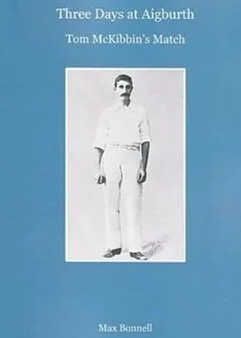
Tom McKibbin was an Australian Test cricketer who played for Sydney University in 1897-98. A new study of his life has recently been published, written by SUCC life member Max Bonnell.

Published: 2024
Pages: 80
Author: Bonnell, Max
Publisher: Red Rose Books

http://www.cricketweb.net/books/three-days-at-aigburth/

In terms of getting this excellent little book published it may, on the face of matters, be serendipitous that Tom McKibbin’s finest performance in First Class cricket was against Lancashire at the Aigburth ground in Liverpool. In truth however I cannot imagine that Red Rose Books would not have published this one anyway, coming as it does  from the pen of one of Australia’s best cricket writers.

The match in question took place in 1896. That summer’s Australian tourists had lost the Test series 2-1, but they had not been beaten by any of the First Class counties so their final such encounter against the Red Rose was not without importance. It was a wet summer and the game was affected by rain. McKibbin, who ended the tour with 101 First Class wickets at 14.26, took 6/27 and 7/11 as Lancashire slumped to scores of 62 all out and 28 all out to lose by 217 runs.

In three separate but non-consecutive chapters, one dealing with each of the three days of the match, the build up to the encounter and the play itself are described in detail. Despite the books title however those chapters are not the main purpose of Three Days at Aigburth, which is first and foremost a biography of a most interesting Australian cricketer.

McKibbin made his First Class bow at 23, and his final appearance less than five years later. In between there were 320 wickets at 19.67, 17 of them at 29.17 in five Tests spread across three Ashes series. Remarkably there was film taken of his bowling action, although sadly that has not been located. An attacking bowler and a big spinner of the ball McKibbin was essentially an off spinner, but one who could also turn the ball the other way. He had a questionable action which Bonnell does his best to describe and, given the obvious difficulties inherent in that given access only to contemporary reports, he does so with admirable lucidity.

As the short duration of his career suggests McKibbin’s is a life interesting for a good deal more than his development as a cricketer. In fact so much did McKibbin do that there remain gaps in the narrative but, thanks to the efforts of a great nephew and the family archive he maintains Bonnell has been able to paint a picture that is much fuller than he could ever have hoped to put together from public records and press reports alone.

Outside the game McKibbin spent four years of his early adulthood working towards qualification as a solicitor and then, via a circuitous route, ended up as a forward thinking and successful sheep farmer, so this is certainly not a book that deals only with an interesting but short lived cricket career.

The book itself is published to the usual high standard of Red Rose Books. There is a decent index, all the statistics that anyone could reasonably want and a decent selection of photographs. The book is available directly from the publisher at £14 inclusive of UK postage and packing and, for those of us who like that sort of thing, there is a limited edition hardback at £38 per copy, but there are only 13 of those.

SYDNEY UNIVERSITY CRICKET: 1852 or 1854 or 1864?

SYDNEY UNIVERSITY CRICKET: 1852 or 1854 or 1864?

•        The Death of Captain Webster.

On the evening of Friday 31 March 1854, Captain Robert Webster climbed the stairs to his bedroom in the Governor’s Quarters of Darlinghurst Gaol. His breathing was laboured; his tread was heavy; he had only a few hours to live. His eldest son, Robert Edward Webster, also climbed the stairs to assist him. His father had been complaining of a cold for some days. Captain Webster, an Irish officer attached to the Garrison in Victoria Barracks, was the third Governor of Darlinghurst Gaol.

By 8.30pm, Captain Webster had been helped into bed but his condition grew worse. Dr Thornton Marshall, Assistant Surgeon of the 11th Regiment, was called from his quarters in Victoria Barracks but before he could arrive, Captain Webster was dead.

A magisterial enquiry was held the next morning. Thomas Harrison, Darlinghurst’s Deputy Gaoler or ‘Principal Turnkey’, thought that Captain Webster had been suffering from influenza. Doctor West conducted the post-mortem examination and concluded that the cause of death, however, had been “a fatty degeneration of the heart, the muscle of which was changed into fat.”

Captain Webster’s death at 47 caused great mourning at his Darlinghurst residence among the members of his immediate family – his wife, Anna, and their ten children. There was also a significant sense of loss at Victoria Barracks for an Officer who had served since 1825.

•        The Postponement of a Cricket Match.

There was another consequence of this tragic death.

The Garrison Cricket Club had arranged to play the Sydney University team on Saturday afternoon at the ‘Garrison Ground’ at the rear of the military barracks which had been opened recently in February 1854.

In view of the circumstances, the teams agreed to postpone the game until the next Saturday, 8 April. Meanwhile, there was a funeral to organize.

 On the afternoon of Monday 3 April, the various Sydney Law Courts adjourned their proceedings so that those wishing to attend the funeral may have been able to do so. Reverend Thomas Druitt, Chaplain of Victoria Barracks, conducted the service at St Stephen’s Church, Newtown, before Captain Webster’s burial at the Camperdown Cemetery in Church Street Newtown.

•        Sydney University cricket begins.

‘The Sydney Morning Herald’ of Friday 7 April announced:

“The match between Sydney University and the Garrison, which was to have taken place last Saturday [1 April] but was postponed on account of the death of Captain Webster, is now arranged to come off tomorrow [8 April] on the ground at the rear of the military barracks.”

And so, on Saturday 8 April, at a ground known variously at the time as ‘The Military Cricket Ground’ or ‘The Garrison Ground’ (now where the ‘Sydney Cricket Ground’ stands), a team of soldiers representing the Garrison played cricket against a team of students representing Sydney University. The Garrison Cricket Club seems to have been formed in 1853-54 and to have played its first game against the Royal Victoria Club on Wednesday 15 February 1854 to mark the opening of the new Garrison Ground in the presence of the Governor of NSW, Sir Charles Fitz Roy. The band of the 11th Regiment played throughout the afternoon. The Garrison Club won by one run when the Royal Victoria Club’s last man was run out.

The Garrison then played at least two more games before meeting the students.

The soldiers who were part of a detachment which was lodged at Victoria Barracks appeared to be older and more experienced than their opponents.

The students were all undergraduates at the University and were aged between George Curtis’ callow 15 years and John Kinloch who was 21.

Where did they learn to play cricket?

What experience did they have in playing cricket games?

How did they form a team to take on the soldiers?

The answers to these questions are elusive.

But we do know something about the cricketing background of some of the students.

16 year old Rodney Stuart Riddell (1838-1907) opened the batting for University and probably faced the first ball in University’s innings, probably the first ball bowled against Sydney University in any game of cricket. Riddell was the son of the Colonial Treasurer, Campbell Drummond Riddell (1796-1858). He had been initially educated at Mr William Cape’s School in Darlinghurst, as was his opening partner, 17 year old Marshall Burdekin (1837-1886). There is no record of any organized cricket games played by Cape’s School but Riddell had certainly played a few games for the Royal Victoria Club, including the game against the Garrison referred to earlier. In fact, it was Riddell who was the last batsman who was run out to give the Garrison victory by one wicket.

Riddell was among the first students admitted to the University in October 1852, having passed the matriculation exams in Greek (‘The Iliad’ Book 5, ‘The Anabasis’ Book 1), Latin (‘The Aeneid’ Book 1, Sallust’s ‘Bellum Catalinae’), Arithmetic, Algebra and Geometry.

Burdekin became one of the first to be conferred with a Master of Arts (1859), a barrister and a Member of the Legislative Assembly of NSW.

Others who played in the game on 8 April continued to play for University for some time but that gives no clue as to how they first learned the game.

Riddell did not finish his Arts degree, becoming a professional soldier, serving in the New Zealand wars in the 1860s, the Afghan Wars (1878-1880) and the War in the Sudan in 1885 as a Lieutenant Colonel. His great grandfather, Sir James Riddell was the first Baron of Ardnamurchon in Scotland and the hereditary title passed to Rodney. He was knighted, probably the first University cricketer to have that honour conferred on him. Thomas Henry Coulson (1833-1862) who had been among the first to be awarded a scholarship to the University in 1854, was the first of this team to die, aged only 29.

University’s first outstanding cricketer, however, was the 21 year old John Kinloch (1833-1897) who had been born in Dublin and who played his first recorded match in 1847-48 (for Union Club at Hyde Park). He was both experienced and talented, bowling fast underarm. One contemporary wrote that he “takes but a short run and delivers the ball sharply with a very rapid pace, very straight along the ground. His bowling has a peculiar ‘spin’ and is therefore successful.” He seldom scored runs, however, and was a “stiff and heavy” fieldsman who played with a monocole because of his short-sightedness.

Kinloch was eventually a prolific wicket-taker in club matches and he played three times for NSW against Victoria, each time on the losing side, taking 12 first-class wickets at 11.16 and scoring just 5 runs.

He was an important figure in NSW cricket, chairing the first meeting of the NSW Cricket Association in 1859. For many years, he was the secretary or the organiser of the University teams. It was he who reported in 1859 that University had first played cricket in 1852 and that the club had been formed in 1852 but there is no evidence for this claim. It seems highly unlikely that games involving Sydney University would have been played in 1852, given the fact that the University was established by an Act of the NSW Legislative Council in only September 1850; that the first meeting of the Senate of the University took place on 3 February 1851; that the first matriculation exams took place on 4 October 1852; that the inauguration ceremony took place (where Sydney Grammar School now stands) on 11 October 1852; that the first 24 students were admitted only in October 1852. If University did play any games in 1852, the team would have been selected from only 24 undergraduates.

•        The game on 8 April 1854

If the soldiers were expecting to have an easy time of it against the young students, especially when the Garrison led by 16 runs on the 1st innings having made 49 to University’s 33, they may have been unprepared for a significant comeback.

The pitch was challenging for batting. ‘Shooters’ were common. Bowling was either underarm or round arm. Bats were rough-hewn. The ball was smaller than its current version. Batsmen wore no protective equipment. Players wore coloured shirts and buckskin boots. There were no boundaries and batsmen had to run all their ‘notches’. It appears that not all 22 players were available for the entire match. Private Fry was replaced by Private Hartnett in the Garrison’s 2nd innings and, for University, James Bowman batted in the 1st innings but was replaced in the 2nd innings.

No bowling figures were recorded and bowlers were credited with wickets only when the batsman was out bowled. So Kinloch took at least eight wickets for the match, George Leary took at least three, Coulson at least two and James Wilson at least two.

In their 2nd innings, the Garrison succumbed to the bowling of Kinloch and George Leary. Private Plank top-scored with 10. Byes were next top-scorer with 5. University was left with 51 to win and steady batting, even from Kinloch, who was inevitably run out but not before he had got to double figures, saw University home by 2 wickets.

•        More cricket in 1854

On Monday 10 April, on a day of drizzling showers, Kinloch and Coulson represented The Junior Marlebone (sic) Club against the Union Club at Hyde Park.

Sunday 16 April was Easter Sunday and no games were scheduled over the Easter season.

Then, on Saturday 22 April, at the Garrison Ground, the two teams met again. University’s team was unchanged except that Burdekin’s place was taken by David Scott Mitchell, a name easily recognized. When he died in 1907, he left his vast collection of books and an extraordinarily generous gift of 70,000 pounds, to the State of NSW. The Mitchell Library still bears his name. In this game, however, he was bowled by Captain McDonald for 0.

  University won convincingly by 8 wickets. Kinloch’s bowling was irresistible. In the Garrison’s 1st innings of 49 of which Captain McDonald made 14, Kinloch took 7 wickets. When the soldiers went in again, 19 behind, after University’s George Curtis made easily the highest score of the match with 26, Kinloch took another 4 wickets and University had 20 to win. Remarkably, Kinloch swiped 12 not out and University lost only two wickets in passing the score.

‘The Sydney Morning Herald’ was fulsome in its praise:

“On the university side, during the first innings, the batting of Messrs Lee [who made 10] and G Curtis was very good; and in the second innings, that of Mr Kinloch, while his bowling we can venture to say, was scarcely ever surpassed in this country.”

The next Saturday, 29 April, University played its first three-aside match against the Bank Club. So dominant were the three University players that Rodney Riddell scored all the runs and Ed Lee took all the wickets without the third University player meriting a mention. In the following days, one more three-aside game and a two-aside game were played between University, represented by Riddell and Lee, and the Bank, a side formed from players who worked at one or two of the banks in Sydney. University won both games, so that by the end of its first season, University had been victorious in all five of its games.

The emergence of the University teams did not carry much permanence. Only one game was played in 1854-55 (when University fielded five players who had not played in 1853-54) and none in 1855-56.

•        The Sydney University Cricket Club is formed in 1864

The University moved from the city to its present expansive site in 1855 and, by 1857, had adopted the Coat of Arms and the motto (“Sidere Mens Eadrem Mutato”- “The mind stays the same while the stars change”).

By 1864-65, the Club which owed so much to Kinloch’s leadership and enthusiasm was formally re-constituted or re-formed with a written constitution and colours. This Club, whose date (1864) is on the badge of the Sydney University Cricket Club, reappeared on 20 April 1865. Its opponent was the Military & Civil Club (a successor to the Garrison Club) and the game was played at the ground formerly known as the Garrison Ground which was then called the ‘Military & Civil Ground.’

We can say with some certainty, however, that a team known as ‘Sydney University’ played ‘The Garrison’ in 1854, 170 years this season.

James Rodgers


Golf Day 2024🏌️

Golf Day 2024🏌️

Golf Day 2024🏌️

The SUCC Annual Golf Day takes place on Friday May 3rd.

Save the date! More details to follow.