Nivethan Radhakrishnan Representative Selection

Congratulations Nivethan Radhakrishan on your selection into the NSW Metropolitan U/19 Selection!

Niv has 41 wickets @ 18.00 for the season and has played a key role in the success of both the 1st Grade and Poidevin-Gray Squad this season.

Niv was exceptional as captain of the PG’s Squad during our FDC T20 Day Fixture against Penrith, in which the Students won by a comprehensive 7 wickets.

Professor AD (David) Buckingham Obituary

Professor AD (David) Buckingham CBE, FRS, FAA died on 4 February 2021 aged 91.

Professor Buckingham was one of the  most distinguished who have ever played for the Club.

An appreciation from the ‘Sydney Morning Herald’ of 3 March 2021 appears below.

Professor Buckingham played for the Club from 1949 (beginning in 4th Grade in 1949-50) until 1953 (finishing with two seasons in 1st Grade), mainly as a top order batsmen and occasional off spinner. He made his only century in low-scoring seasons, when his 103 was instrumental in 2nd Grade’s victory over Cumberland in early 1952, the game before he was deservedly promoted to 1st Grade. He was awarded a Blue for Cricket in 1952.

When he studied at Cambridge University, he represented Cambridge in ten 1st class games. Although he spent most of his  years in England after graduation from the University of Sydney, Professor Buckingham continued to take a practical interest in the Club and was a Member of the SUCC Foundation.

1st class cricket 1955-60:

Matches Innings Not Outs Highest Score Runs  Ave    Wkts  Runs Ave

    10           20           1               61                349   18.4        0      43       - 

SUCC 1st Grade 1951-53:

Innings     Not Outs      Highest Score    Runs   Ave     Wkts   Runs   Ave

15                 2                    67no               501      29.5        0        11     -

SUCC all grades 1949-53

72                7                    103                1586     24.4         3       84     28.0

James Rodgers


The Sydney Morning Herald - Wednesday, 3 Mar 2021 - Page 34

‘A laser-like focus on the forces of the universe’

Professor A. David Buckingham was one of the world’s leading molecular and optical scientists. He explored the fundamentals of physical phenomena as diverse as intermolecular forces (relevant to aspects of molecular biology and genomics) and nonlinear optics (intrinsic to laser-based technology and telecommunications). Based in England for most of his career, he was clearly proud of his Australian origins.

David grew up in Pymble with parents Reginald and Grace (nee Elliot) and twin siblings Joslin and Michael. Reginald and Grace had emigrated separately from England to Australia before World War I. Reginald worked for Dalgety and Company Limited, dealing with stud animals. Grace had trained as a nurse and was a pioneer of Australian baby health clinics. David’s unusual first name was in memory of Grace’s brother, John Amyand Elliot, who died at Gallipoli in 1915 aged 24.

David was sent to Barker College, where he excelled at cricket and on the rugby field . Both David and his brother, Michael, entered Sydney University’s faculty of science, where each won a University Medal (Michael’s in physics and David’s in chemistry) before they took their respective doctorates in England.

At Sydney University, David’s BSc Honours and MSc research projects were supervised by Professor RJW Le Fevre, a renowned physical-organic chemist. David’s cohort of firstyear undergraduates in 1948 was exceptionally gifted, including four who later became fellows of The Royal Society (FRS). Many of his contemporaries went overseas for doctoral studies before returning to enhance the pool of academic staff in Australia’s maturing universities.

In 1953, he was awarded the Shell Postgraduate Scholarship and chose to study for a PhD at Cambridge in the Theoretical Chemistry Department headed by Professor JE Lennard-Jones – a famous name in the field of intermolecular forces. However, Lennard-Jones was moving away from Cambridge and David was supervised by Dr John Pople, who was only four years older than he (and who went on to win a Nobel Prize in 1998). Together, they made important scientific discoveries that are significant to this day.

After gaining a cricket blue at Sydney University in 1953, David played rugby in Cambridge and English first-class cricket (1955-60 ). He later became one of the longest-serving (1990-2009 ) presidents of the Cambridge University Cricket Club.

After completing his PhD, Buckingham held chemistry lectureships at Oxford University with college responsibilities at Christ Church. Although primarily a theoretician, he also initiated key experiments at the National Physical Laboratory in Teddington.

There, Dr RL Disch and he accomplished an ingenious experiment to measure the electric quadrupole moment of carbon dioxide molecules. The ‘‘ Buckingham’ ’ is now the CGS unit (centimetre, gram and second measurement system) for this structural property of any molecule, indicating its charge distribution and strength of interactions with other molecules.

His equipment was moved to Bristol University after he took up its inaugural Chair of Theoretical Chemistry in 1965. It may have surprised the Bristol management that a theoretician needed more than office space, pencils, paper and computer time.

Buckingham’s time in Bristol was cut short by his return to Cambridge in 1969 as professor of chemistry and head of the Theoretical Chemistry Department, with a fellowship in Pembroke College. He attracted an impressive team of students, research scientists and academic staff to the department, establishing an enduring tradition of research on a variety of topics.

He lectured the main quantum mechanics course at Cambridge for more than 25 years. He aimed to make his lecture material intellectually demanding, challenging the most able students in the class. With elegance and clarity, he tended to focus on a single topic and treat it as thoroughly as possible.

His lectures were often attended by other academics who were keen to learn what they could from him. On one such occasion in Bristol, he asked his audience: ‘‘ Is that clear?’’ . The loud response from a senior colleague was: ‘‘ No, it is not.’’ Using his best cricketing skills, Buckingham played a straight bat and explained, patiently and respectfully, the point that his much-respected colleague had missed. This incident was regarded in awe by PhD students who were present.

His research expertise has produced discoveries ranging widely from basic physics to molecular biology and from materials science to chemical engineering, all of which are influenced by properties of individual molecules and interactions between them. Buckingham had the foresight to recognise many such applications far in advance of their practical realisation. For instance, the nonlinear-optical phenomena inherent in electro-optic processes that he pioneered, both theoretically and experimentally, are at the core of modern fibreoptical telecommunications and laser technology.

He also made a substantial contribution to scientific publishing as editor of several leading international journals in the field of chemical physics. At scientific seminars, he would usually ask a provocative or probing question of the speaker. He had a quick-witted ability to perceive the merit or frailty of an argument, but always behaving as a perfect gentleman – sometimes with a dash of the Australian larrikin. In 1973, at a conference in Houston, Texas, his fearless questioning challenged Dr Edward Teller, so-called ‘‘ father of the hydrogen bomb’’ .

Around the world, many distinctive honours and awards were bestowed on David. These included his FRS (1975), his Foreign Associateship of the US National Academy of Sciences (1992), his CBE (1997), and his Corresponding Membership of the Australian Academy of Science (2008).

Cambridge was his final resting place. His retirement at age 67 was marked in mid-1997 by a memorable scientific and social symposium at Pembroke College. He remained active in the university and on the international conference circuit for over 20 years after that.

Throughout his distinguished career in the northern hemisphere, David maintained active interests in Australian science (not to mention cricket and politics). A warm welcome always awaited him in numerous Australian research centres. His lectures and personal interactions during regular visits to Australia influenced many young scientists here, some of whom worked in his research groups in Bristol and Cambridge.

Enriching his life were his wife, Jill (nee Bowles), children Lucy, Mark and Alice, and eight grandchildren (one born in Australia). The atmosphere in the Buckingham household was always happy and hospitable. Jill and David had met in July 1964 on a trans-Atlantic liner bound for Canada and they were married in Oxford 12 months later. Jill, a physiotherapist, brought shared interests, astute guidance and unfailing support to their partnership of more than 55 years.


Brian Orr

Alan Crompton 80 Not Out

On this day (28 February), 80 years ago, Alan Crompton (Crommo) was born in Sydney.

The Club, which is forever in his debt, now joins together to wish Alan the very best on reaching an age of much significance.

Alan played 1st Grade, firstly for Waverley (now known as Easts) and then for Sydney University, from 1958 until 1980, as a wicket keeper/batsman who scored 4768 runs in 1st Grade and took over 300 dismissals. In all Grades for both Clubs, in a playing career spread over 26 seasons, he scored 7266 runs.

But far more than any statistical analysis might reveal, one cannot think of Sydney University Cricket Club without thinking of Alan Crompton, one of the giants of the Club, who over the last 60 years has  so often held positions of deeply symbolic importance as he often represented the Club in much wider fields. He has always been able to mirror the Club to itself; to give expression to its soul as he stood for the highest ideals and traditions of the game.

In turn, he was Social Secretary, Honorary Secretary, a Vice President, a widely respected delegate to the NSWCA, President for 22 years and then Patron of the Club for a further 17 years.

He rose to great heights: Chairman of the NSW Board, Chairman of the Australian Cricket Board, Manager of Australian touring sides to New Zealand, Pakistan and India. And he was awarded the Order of Australia Medal, Life Membership of Cricket NSW, Life Membership of Sydney University Cricket Club, Blues for Cricket and Baseball. But his humility, graciousness and sense of service would never rest on these considerable laurels nor ever stand in the way of others. He is a highly valued friend to so many.

Crommo has set the standards in so many ways. The Club’s current position of success and the respect and regard in which it is held can be traced directly to Alan Crompton.

Alan, every good wish on your birthday and ad multos annos!

James Rodgers

Alan.Crompton.web.jpg

O’Sullivan / O’Keeffe Trophy

O’Sullivan / O’Keeffe Trophy

This Saturday the Students will bring their A game as they look to retain the trophy against a proven one day St George side 🔥

Venue: Hurstville Oval
Date: Saturday 20th February
Time: 10:00am

See you there 📸

GREEN SHIELD : SELECTION TRIALS 2021/22 SEASON

GREEN SHIELD : SELECTION TRIALS 2021/22 SEASON

Dear Junior Cricketers,

Sydney University Cricket Club (SUCC) is proud to launch its A. W. Green Shield Program for 2021-22 Season, and invites any interested cricketers aged between 14 to 16 years old to register their details.

TRIAL DETAILS:

Friday: 9th April - 4pm to 7pm

Sunday: 18th April - 5.15pm to 8.15pm

Friday: 23rd April - 4pm - 7pm

Saturday: 1st May - 9am -12pm

Friday: 7th May - 4pm - 7pm

Venue: (Indoor Cricket Centre SUFG Grandstand) Regimental Drive Camperdown.

The sessions will include batting, bowling, and certain fielding skill sessions with our professional coaches. This is only the initial training session and will be followed by more intensive sessions throughout the off season.

SUCC may invite a small number of cricketers to attend specialist sessions to assist talented players in developing skills to the level we expect our players to be at. These will be by invitation only, and invitation does not mean those players will be automatically selected in the A.W. Green Shield Program.

We have experienced large registration numbers and unfortunately can only include additional players by invitation only from 3rd March onwards.

anandkaruppiah2020@gmail.com

We look forward to your attendance.

IMG_9598.jpg

 Sydney University v Melbourne University. 150 years ago: Christmas Eve 1870

Sydney University v Melbourne University. 150 years ago: Christmas Eve 1870

150 years ago, early on the afternoon of Saturday 24 December, two batsmen strode out to the middle of the Melbourne Cricket Ground to open the batting for Sydney University in the first inter-varsity match ever played in Australia. It was only sixteen years since the ground had first been used for cricket; only sixteen years since Sydney University had played its first match; only fourteen years since the Melbourne University Cricket Club had been formed.

Sydney’s Richard Teece, wearing a uniform that consisted of a white straw hat, a blue and gold sash and a nondescript shirt with red checks, faced the first ball from Melbourne’s Harry Jennings. It was Teece, an inveterate organiser, who had arranged the game during a visit to Melbourne earlier in the year. In England, Oxford and Cambridge had had begun their games at Lords in 1827 and it was Teece’s vision, drawing on England’s experience, that now established the two Australian Universities’ contests.

The match began on Christmas Eve. Christmas Day was a day of rest and religious observance, well appreciated by the Sydney players who had set out from Sydney on an arduous journey south earlier in the week. The game resumed on Boxing Day and concluded on 27 December.

 The Sydney team included four current or future first class players (Richard Teece, Monty Faithfull, Thomas Iceton and Joseph Coates) but the home side included seven Victorian representatives.

Scores, as was usual at the time, were relatively low but Sydney’s 109 was enough to give them a slender lead of two runs on the 1st innings.

Iceton, Faithfull and Coates scored 90 runs among them in the 2nd innings and Melbourne was set 130 to win.

“[Louis] Goldsmith made a rapid start, taking twenty runs from the first three overs of the innings, and his opening partnership with David Wilkie was worth 57 until Faithfull induced him into a skied drive. Faithfull grabbed two more wickets before stumps on the second day. On the final afternoon, Melbourne still needed 33 runs when its sixth wicket fell, but a vital stand of 30…settled the issue, even though Faithfull caused a late scare before a’Beckett hit the winning boundary.”

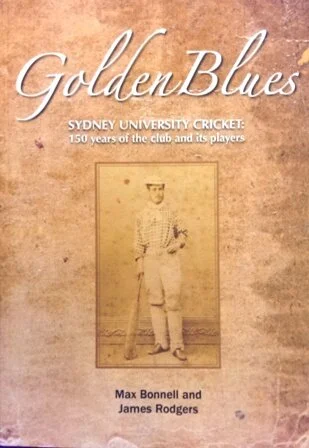
If you want to read a more comprehensive account of the game and the scores, what better resource than Bonnell and Rodgers’ ‘Golden Blues’, pp16-18.

But three other aspects of this momentous trip south 150 years ago bear re-telling.

Firstly, on the afternoon of 23 December, the two Universities contested the first Australian intervarsity boat race on the Yarra River over a distance of 3.5 miles. 1500 spectators crammed aboard steamers or lined the river banks and they saw Melbourne’s four man crew (of whom only DW Wilkie played in the subsequent cricket match) defeat Sydney’s all cricketing crew (EA Iceton, bow, E Barton, R Teece and Alan Yeomans, stroke) by four lengths.

Secondly, ‘E Barton’ was later Sir Edmund Barton, a brilliant scholar, a first class cricket umpire,  a successful politician who became the first Prime Minister of Australia (still the only member of the Sydney University Cricket Club to serve as Prime Minister of Australia), one of the first judges of the High Court of Australia. But, he was a dismally poor fieldsman and an indifferent batsman. Records of his matches for Sydney University are incomplete but in matches for which records survive, in 74 innings, he scored just 517 runs.

Thirdly, from that 1870 match, two cricket bats still survive.

One was presented to Monty Faithfull. His valiant efforts could not prevent Melbourne’s narrow victory but his captaincy, his 7 for 19 in Melbourne’s 2nd innings and his 37 in Sydney’s 2nd innings provoked generous admiration, expressed in the bat’s gold inscription:

“Presented to HM Faithfull esq by the MUCC, as a mark of appreciation of his splendid bowling in the Inter Varsity Match 1870.”

The bat had been long forgotten until, in 1956, the Sydney University Cricket Club’s President, Captain John Morris, ordered the University No1 Grandstand to be cleared out and Faithfull’s bat emerged from piles of rubble, with the inscription still intact.

The other bat was used by Richard Sly who batted at no8 in the 1870 match. Ten years ago, his great grandson, Terrey Johnson, presented this bat to the Club.

Both bats are currently held in the  Sydney Uni Sport and Fitness offices.

150 years ago this week, a tradition of friendly rivalry between Australia’s two oldest universities was established.

And for that, we should remember with fondness the Sydney pioneers:

Richard Teece

Edward Iceton

Thomas Iceton

Monty Faithfull

Alan Yeomans

Joseph Coates

Edmund Barton

Richard Sly

JJ Teece

John Thompson

GE Long

TJ Plomley (scorer) and TP Miller (umpire)

James Rodgers
IMAGES AT FINE LEG - By James Rodgers

IMAGES AT FINE LEG - By James Rodgers

                                    IMAGES AT FINE LEG. December1986.

 The pavilion yawns in concrete behind me.

Once, we stepped out from a ramshackle antique grandstand which cast its white-anted wooden shadows on the turf of ages.

Now white concrete shimmers in chartered squares.

Trees surround the ground but no branch softens this tribute to the utilitarian age.

This lacklustre morning, dry with December heat, holds little interest. I ride the boundary. Is it possible to feel so little enthusiasm half an hour into a game?

Legs stumble. Hands fumble. Arms flail. The throw is wide. Distant flickering flannels back up.

When will I bowl?

 Military overs pass by. Runs trickle. Maidens accumulate in fragrance of dust.

Why doesn’t he bowl me?

Which picket was split by Nothling’s rifle shot drive in 1920?

Did Taylor, fleet of foot,  scorch this piece of earth during his 253 over sixty summers ago?

Can I bowl now?

We defend in the infield.

I’m left to the humming cicadas in the outfield.

The distant carillon rings out Christmas carols. Deep and crisp and even?

No crispness here. Just lethargic moments.

Bat on ball is a distant thud. They’re playing another game.

When will I bowl?

 He signals.

“Next over. This end.”

 I walk tall. Roll up my sleeves.

 James Rodgers