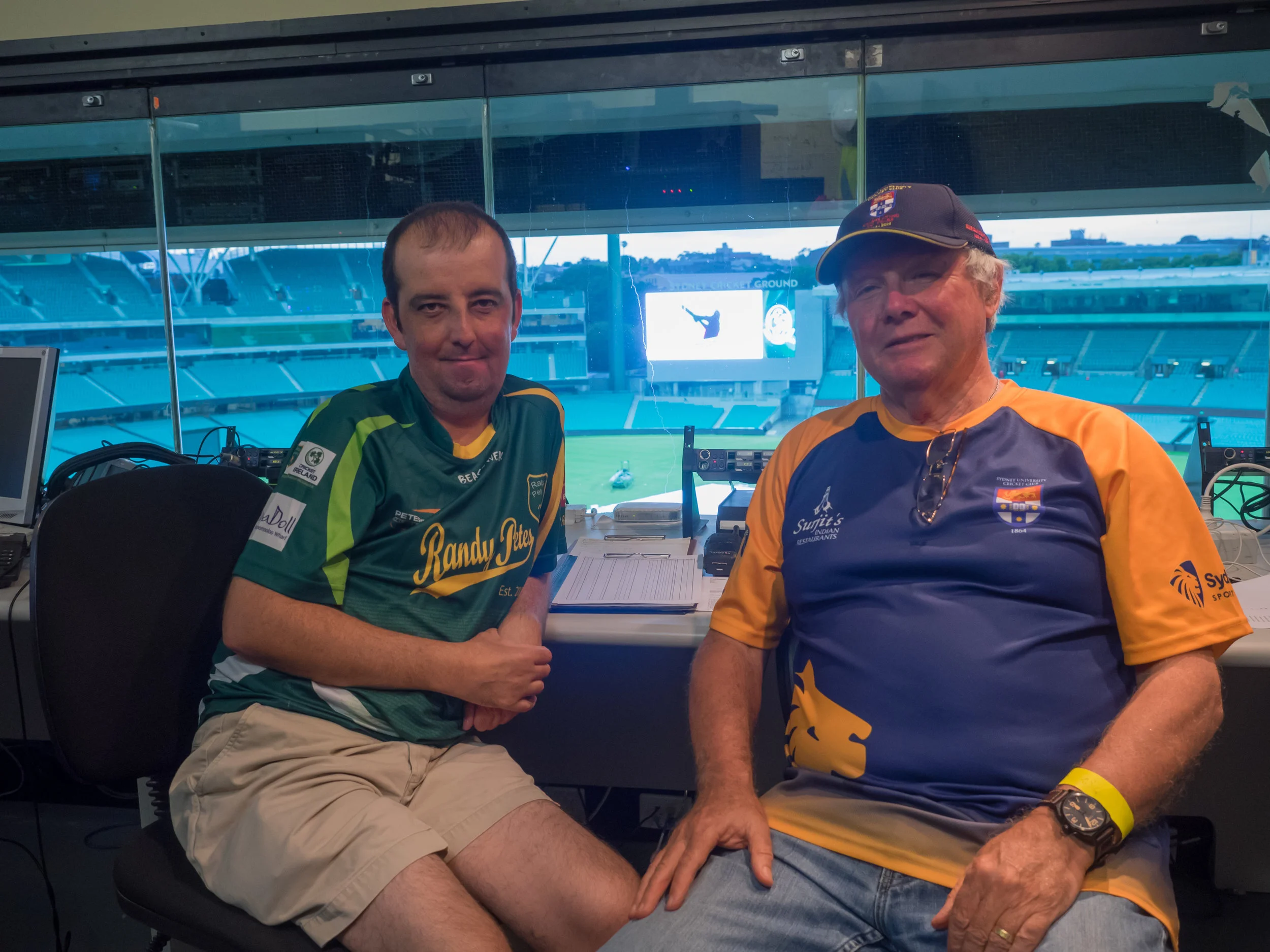
Neil-Smith and Malone keep NSW Metro on top

Neil-Smith and Malone keep NSW Metro on top

NSW Metropolitan and Western Australia were the two undefeated teams in this year's Under 19 National Championships going into their match at Adelaide's Railways Oval today, but Sydney University's Lawrence Neil-Smith and Devlin Malone helped to ensure that the contest was never a close one.

After NSW Metropolitan had posted a competitive 9 for 254 from its 50 overs (Gordon's Axel Cahlin hitting 91), Lawrence-Smith knocked the top off the WA innings, trapping both openers lbw inside his first two overs.  Reduced to 2-4, WA threatened to recover only briefly, when the fourth wicket added 44 in rapid time, but Malone came on to strangle the middle and lower order, allowing only 17 runs from his first six overs.  WA was dismissed inside 35 overs for 142, giving NSW Metropolitan a conclusive victory.  Malone took the bowling honours with 3 for 40 from ten overs, while Neil-Smith ended with 2 for 24 from 7 overs.

NSW Metropolitan defends its unbeaten record against the Northern Territory tomorrow.

You might not remember... the Holdsworth-Gardyne Trophy

You might not remember... the Holdsworth-Gardyne Trophy

Although you’ve probably seen it. 

It sits in the trophy cabinet at the University Grandstand, an impressive silver cup, 27 inches high, crafted by silversmiths in Sheffield – a dimly-remembered relic of the first attempt to create a systematic club cricket competition in Sydney. 

Club cricket began in Sydney some time in the first decade of the nineteenth century.  Matches were originally played between two clubs for a stake, with enthusiastic support from gamblers.  Sydney University played its first recorded match in 1854, and around that time a number of other clubs formed – especially Warwick, Albert and Carlton – who attracted the majority of Sydney’s leading players.  And yet there was no structured competition.  By common consent, the cricket season began at the end of September and, if the weather was good enough, it could linger on until the start of June.  During those months, the “senior” clubs, as they became known, scheduled matches against each other on a casual basis, but no-one thought of forming a league or playing for points.  In 1870, the New South Wales Cricket Association donated a “Challenge Cup” for competition between the leading clubs, but contests for this trophy (which University held briefly in 1871-72) failed to attract lasting interest.

In September 1881, however, Holdsworth & Gardyne, a firm of ironmongers based in George Street, donated a trophy “to be competed for by the senior clubs, to be retained by the club winning it in three successive seasons”.  This compelled the NSWCA to do something it had never done before, which was to draw up a schedule for a competition.  This wasn’t a hugely complicated task, as there were only four clubs to accommodate, and the Association published a schedule which called for each team to play the other twice, home and away, between October 1881 and April 1882. 

The competition did not begin well for University.  Drawn against the Carlton club, it spent the whole of the first day in the field, as Carlton compiled 8 for 264.  Charles Bannerman, who had scored 165 in the very first Test match four years earlier, was dismissed for only 17, but his brother Alick, another Test opener, batted for most of the day for 117.  Carlton pressed on to reach 301 on the second day, but this was a strong University side, which contained three Test players (Sam Jones, Tom Garrett and Reg Allen) and five others who at some time appeared in first-class cricket (Richard Teece, Joseph Coates, Dr William Wilkinson, Theodore Powell and Monty Faithfull).  Jones, a brilliant attacking batsman, hit a rapid century and University took a first-innings lead of 53.  After Carlton succumbed cheaply in its second innings, University completed a comfortable victory. 

University performed a similar escape act in its second match, against the powerful Albert Club.  The early stages of the game were dominated by Dave Gregory, Australia’s first ever Test captain (and also, just once, a University player).  Gregory hit 71 and took 6-44 as University was forced to follow on, 116 runs behind on the first innings.  But Jones blasted another century, and Reg Allen hit one of his own – the pair shared an opening stand of 231.  University left Albert with 212 to win, and took the match by 71 runs.

These games provided enthralling cricket, and were well-supported by the public.  But the shambolic nature of the competition was soon exposed.  The NSWCA had provided for each match to occupy two weeks; but, as they were played to a finish over four innings, both the Carlton and Warwick matches extended over four days.  Nor had it occurred to the Association to establish any means of scoring points.  Even though the entire competition consisted of only 12 matches (six for each of the clubs), it was not completed during the season, and in September 1882, the Association announced that the return match between University and Albert, which would decide the winner of the trophy for 1881-82, was to be played in October.  Albert won that match, which left the Association with a problem – as each of Albert and University had won the same number of matches, and there was no points system to separate them, the trophy was still without a winner.  As a result, although teams had already begun their matches in the 1882-83 competition, a final was scheduled to decide the winner for the previous season.  It was played at the Association Ground (now the Sydney Cricket Ground) and Albert was boosted by the appearance of the legendary fast bowler Fred Spofforth, recently returned from taking 14 wickets in Australia’s thrilling victory (by seven runs) at The Oval.  Spofforth was expensive in his opening spell, as Sam Jones and Tom Garrett (both of whom had also played at The Oval) cracked 38 runs from his first six overs, after which Reg Allen hit a half-century.  The game lasted for four days, but University forced Albert to follow on and eventually cruised to victory by eight wickets – a task made easier by the fact that Spofforth could not be bothered to turn up for the last day of the game.   One third of the way into the 1882-83 season, University won the Holdsworth-Gardyne Trophy for 1881-82.

In February 1883, the Association announced what everyone else already knew -  that the “rules of the competition were very defective” – and formed a committee to improve them.  It was decided that, if University retained the trophy in the new season, it would become its permanent holder.  And, in the event, University had little trouble retaining the trophy.  This was one of the strongest University teams ever assembled, including four Test players – Garrett, Jones, Allen and Roley Pope – two of whom (Garrett and Jones) were the most effective all-rounders in New South Wales.  But its trump card was Monty Faithfull, a lawyer who sported extravagant whiskers and bowled at a lively fast-medium pace.  Faithfull received only two opportunities in first-class cricket, although he performed well: in his second and last match, he helped to defeat Victoria by taking three for 16 from 27 overs.  But at club level he was devastating: his 619 recorded wickets for University cost him only nine runs each.  Faithfull took 4-11 and 5-49 to help Tom Garrett (5-41 and 5-43) rout Warwick.  Then, when University managed only 136 against Carlton, and appeared to be headed for defeat, Faithfull triggered a collapse.  After taking a first innings lead, University amassed 356 in its second attempt.  

Now only the Albert Club stood between University and the trophy.  University began uncertainly, losing its first four wickets for only 18 runs, before Roley Pope’s 55 pushed the total up to 155.  That appeared modest enough when Albert reached two for 84; but Theo Powell, who seldom bowled, snatched 6-14 as Albert’s last eight wickets tumbled for only 26 runs.  University then produced a collapse of its own, losing its first six wickets for 19 before a few slogs from Faithfull lifted the score to 56.  Albert needed 102 to win, but Sammy Jones decided the game with a masterful spell of medium-paced bowling, taking 5-33 to dismiss his opponents for only 71. 

That brought the competition to a close, permanently.  There was a tangible sense of relief within the Cricket Association when the trophy was delivered, forever, into the custody of the University club.  Another ten years would pass before the Association dared to attempt another structured competition – and, this time, Sydney University was the only one of the old “senior” clubs to survive.  The new participants were clubs newly formed to represent districts, and the competition, known at first as “Electorate Cricket”, still exists, in essentially the same form, as Premier Cricket.  And the Holdsworth-Gardyne trophy sits on its plinth in the Grandstand, a reminder of the fact that Sydney University is the one club in Sydney that successfully bridged the old form of club cricket and the new.

Milestones Monday

Milestones Monday

Damien Mortimer's brilliant 115 against Mosman was his second century for Sydney University, and the fourth of his First Grade career.

Tim Ley's invaluable 55 against Mosman was the fourth half-century of his First Grade career.

Hayden Kerr made his First Grade debut in the thrilling Twenty20 one-run victory against Bankstown.

During his brisk opening innings in the Twenty20 match against Bankstown, Liam Robertson passed 2000 runs in First Grade.

Ryan McElduff made his Second Grade debut, hitting 32 against Mosman.

Charles Litchfield's 103 against Mosman was his second century for the Club, his second in successive innings, and his first in Second Grade.

During his unbeaten 28 against Mosman, Jono Craig-Dobson passed 500 runs for the Club.

Tom Kierath's 55 against Mosman was his first half-century in THird Grade.

AJ Grant's 5-53 against Mosman was his best analysis in Fourth Grade and his second five-wicket haul for the Club.

Devlin Malone and Lawrence Neil-Smith made their debuts for NSW Metropolitan Under-19 today at the National Under-19 Championships in Adelaide, sharing in a conclusive victory over the Cricket Australia XI.

ROUND 7, DAY 1 RECAP AGAINST MOSMAN

ROUND 7, DAY 1 RECAP AGAINST MOSMAN

1st Grade:

Sydney University 10/267 (D Mortimer 115, T Ley 55, M Day 5/39) Mosman 3/17 (T Ley 2/5)

The students entered round 7 brimming with confidence after their dominant victory over the previously undefeated Grodon in round 6. Skipper Larkin won the toss and elected to bat on what looked like another very good cricket wicket.  Good bowling by the Mosman quicks saw us in a bit of trouble with both Larkin and Carters out before the score had reached double figures, brining Greg Mail and Damien Mortimer to the crease.  These two dug in and scrapped along getting the score to 42 before mail was caught for a dogged 15.  May and Robertson both came and went leaving us struggling at 5/91.  Ben Trevor-Jones joined Mortimer and these two battled hard, pushing the score up past 140.  Trevor-Jones’ 80 minute stay was instrumental in allowing the students to post a relatively respectable score, he and Mortimer batted with fantastic patience and calmness before he was dismissed for a vital 20 runs.  This saw Tim Ley join Morts, and these two wrestled the momentum back from Mosman and put on 110 for the 7th wicket.  Mortimer brought up his second hundred for the season and pushed his season average up past 80. Damien once again batted with poise and control during his 210 ball stay at the crease.  Tim Ley brought up his first half-century of the season before they were both dismissed in quick succession which brought Ben Joy to the crease.  Needless to say Ben’s innings was short and eventful, scoring 8 off 4 balls including what has been described as a “dirty slog sliced over cover for six.”

Eventually we were dismissed for 267 in the 85th over, with 9 to bowl in the day.  Tim Ley fresh off his half-century terrorized the Mosman batsman bowling with great control and pace, well supported by all the quick’s.  Dugald Holloway took his first wicket in first grade for the year as well, catching the edge for a sharp catch at gully by Ashton May

2nd Grade: 

Sydney University 9/289 (C Litchfield 103, D Miller 43, H Kerr 38, T Slack 4/69)  

The students arrived at Allan Border Oval sitting at tenth on the ladder with a 3/3 records to take on the 5th place Mosman.  An uneventful nil all draw at Nash preceded the new warm up game “shot at the Nash ball”.    Skipper Dave Miller won the toss and quickly chose to bat. 

William Hay and Jack Holloway headed out to open the innings against a very disciplined attack.  The first breakthrough quickly became three as we found ourselves struggling at 3/25.  Charles Litchfield, fresh from his 109* in 3rd grade last round, joined skipper Miller at the crease and battled through to lunch with the score sitting at 3/83. 

Soon after lunch, Miller departed for a solid 43 brining Hayden Kerr, also fresh from an unbeaten 100 last week in third grade. Kerry and Litchfield love batting together, after putting on 235 last week they put on a very respectable 69 in quick time, before Kerr departed for his highest second grade score of 38.   Crowley was unlucky to be dismissed first ball to a fantatic delivery, which brought NSW U17 All-Rounder Ryan McElduff to the crease in his debut 2nd grade game.  Ryan and Litchy combined beautifully batting with patience beyond their years putting on a 90 run partnership.  Charles brought up his second successive hundred and third for the year just after tea quickly followed by McElduff for 32 off 107 balls.  This brought Jonathon Craig-Dobson to the crease with the score 7/257.  Birdy who has had a tough start to the year with the bat decided it was best to hit out or get out and powered his way to 28 off just 16 balls to help the students finish the day on a very respectable 9/289.

3rd Grade:

Sydney University 8/296 (M Powys 68, TKierath 55, A Shaw 53, M Ali 3/57)

A highly contentious and heated game of Nash ended with the 2 all draw, giving old the victory and ensuring Lewis McMahon remained ropable for the remainder of the day.  As per usual, Ash Cowan lost the toss, and we were sent in on a hard but green deck. 

Despite Tom Kierath trying to get out first ball, we rocketed to 0/76 with TK brining up his first fifty for the year and his highest score in the grade. Nick Arnold, joined Ryan Danne and the two of them ticked along nicely bringing up the 100 in the 25th over before Nick chipped one to cover. This brought Ed Arnott to the crease and its fair to say that his dismissal was one of the more unusual and unlucky dismissals, somehow managing to kick a ball from outside leg stump onto his off stump while trying to leg glance.  Ryan followed Ed shortly after and we went into two in a relatively precarious position of 4/119.  However Alex Shaw and Matt Powys quickly grabbed the momentum back and both struck dominant 50s. Shawry surprised everyone by outscoring Matt as the pair brought up their 100 partnership.  Shawry’s dismissal brought about a mini collapse losing 4/22 including skipper Cowan first ball. 

However this brought together Kieran Tate and Lewis McMahon.   These two added 52 very handy runs, with McMahon doing his best to frustrate the opposition into submission with a handful (or more) of cover drive play and misses.  Tate ended up 25* with McMahon up the other end with a season high 28* ensuring we finished the day with a respectable total.  

4th Grade:

Mosman 10/165 (L Kimber 66, N Heath 37, AJ Grant 5/53 off 26, A Peek 4/32) Sydney University 1/9

Sydney Uni fourth grade arrived at Rawson Park with the wicket looking like a beaten up boxer with spots everywhere. Skipper AJ Grant lost the toss and we found ourselves in the field.  Despite tight bowling from Holcroft and Aidan Peek early on, Mosman put on 82 for the first wicket, and some tight bowling restricted them to 2-106 at Tea. After tea our self-proclaimed rigsman and heroic skipper took control and ensured Mosman were dismissed for 165.  AJ bowled himself into the ground taking 5/53 off his 26 overs. To put this into context in the entire 2015/16 season AJ only bowled 27 overs.  AJ was well supported by Aidan Peek who took 4/32 off 17.  With both bowlers well and truly exceeding their previous PB for overs bowled in the day. 

Aidan’s day was not over as he was elevated to open the batting with last week centurion Jake Day.  Unfortunately Jake’s admission from the SUCC Rare graph had him riled up, however he was unable to convert his anger into runs as he was dismissed brining Nick Powys to the crease.  Nick and Aidan got us through to stumps at 1/8 chasing 166 for victory next week.

5th Grade:

Mosman 7/343 (D Patel 69, A Carre 62, A Nouree 55, Z Islam 3/42)

Another vey tough day for the students, as we were unable to make regular breakthroughs as Mosman batted incredibly well passing 340 in the day.  All our bowlers toiled hard, with Natesh the pick of the quicks with 2/58 supported by Islam who finished with 3/42, supported him. A huge chase is needed on day two to hopefully help get our season back on track and secure some points after a disappointing day 1.

Metro Cup:

Georges River 10/243  (A Salgueira 145) Sydney University 3/42.

It was a mixed day for the students dismissing Georges River for 213 on a decent wicket at Bland Oval.  Alejandro Salgueira scored 145 out of their total and batted exceptionally well, with the students unable to dismiss him or stem the flow of runs. Luckily he was unable to find a partner to go with him and we were able to restrict them to a very gettable target. The students had 24 overs to bat at the end of the days play, and unfortunately lost three relatively key wickets for 42 meaning a huge day two approaches next weekend still requiring 170 with seven wickets in hand. 


IN THE SHEDS... FROM THE SCORERS TABLE

IN THE SHEDS... FROM THE SCORERS TABLE

December is here and there really is no better time of year to be playing cricket...Except, not everyone in the club is out in the middle on a Saturday. There are usually a few spectators viewing the spectacle of a grade cricket match - the fresher girlfriend yet to learn better; the incredibly committed parent; the stalwart patron; the odd hungover college battler; or the occasional cat on the hill…

But committed cricket supporters are a pretty strange bunch. This could explain why one decides to spend their Saturday's scoring for a cricket team...aside from an unhealthy and borderline obsessive relationship with order and numbers.

The Scorer's Club is indeed amongst the rarer group of characters amongst the club patrons, but has definitely produced some of the more memorable. Those who have been around the club a while would remember Martin Amy, who would destroy himself on a Friday night, before running a half marathon to the game to score each Saturday morning. Never short of an opinion, and always willing to impart his sage advice about how your batting technique needed some serious work, or to get that front arm up a bit higher and maybe you'll stop spraying them.

Les Carrington was a true stalwart of the club, devoting his heart and soul to SUCC 2nd grade during his time. With a customary McDonalds bag in tow, Les would spend the day producing mesmerising 360 degree diagrams of a batsmen's innings, to present as a prize for a knock over 50. While easy to take for granted, this was great incentive for the top 6 going through a lean trot, and a rewarding badge of honour for the bowlers who somehow managed to burgle their way to a cheeky half-ton.

Johnny Kilford is another club constant and true gentleman of the club, and somehow always manages to make it to every 1st grade game despite spending the majority of his time travelling around the world. He is a most recent recipient of a coveted 'Gold' and the club is lucky to have him around.

And who could forget Laura the Explorer? I know the scoobydoos certainly won't...

Let’s face it – as a player, the only thing worse than showing up to cricket knowing that you don't have a scorer, is a warm up without Nash ball. It's very rare to see a full time scorer in 3rd or below - which inevitably means not 1, but 2 nuffies trying to balance the books and make small talk.

There are so many inevitabilities. Standard fare is for the youngest/sticks to take the first 10 overs, which will likely turn into 20 as the next in line conveniently disappears to pad up or do a lap. At some point you will need to spend part of the day trying (and failing) to remember how to correctly code a leg bye. For even the most obvious of boundaries, the umpires will still refuse to see an upward raised arm acknowledging their ‘4’ signal. At least once an over someone will ask for the score, even if the last 15 balls were play and misses. Several people will spend great lengths of time 'examining' the book – ie: looking to see how well they went (typically a batsman coming off a decent score or a paceman who took a few poles).

There will be at least one shout of 'bowlers name?' Scoring balls is out of the question for 96 overs, so a vigil in the lower grades will have the boys embellishing that your 20-odd was definitely off at least 200 rocks. A batting collapse leads to as much panic in the scorebook as it does in the sheds. By the close of play the book will be a strange mix of indecipherable calligraphies. And the more recent 'Will Hay' effect means that if you complain loud enough and mess up completely, you will be exempt (banned) from scoring ever again.

On the whole, as a player, scoring leaves you aching to find a spare pair of whites and somehow find your way onto the field. But until then, pass the pen and let's keep this book clean.
 

Player of the Round: Round 6

Player of the Round: Round 6

Voting has been completed for the Sydney Uni Cricket Player of the Round following Round 5 of the McDonald's NSW Premier Cricket competition.

The Surjits Player of the Round goes to Devlin Malone for his second five wicket haul in first grade this year, helping defeat a previously unbeaten Gordon side.

The Nags Head Performance of the Round is shared by third grade destroyers  Hayden Kerr (129*) and Charles Litchfield (109*). 

Devlin took the ball half an hour before lunch on day two, by lunch he had all but secured the win for the students, tearing through the Gordon batting line up. Not relying on any of his team mates, with three of his wickets disturbing the woodwork and then grabbing two caught and bowled to finish with figures of 5/78 off 25 overs

Hayden and Charles shared a 235 run partnership off just 205 balls on day one so it is only fair they share the Nags Head Performance of the Round together.  It was Hayden's second century for the club after his match-winning 100 in the fourth grade grand final last year.  Hayden has started the year very well, building on his scintillating 64 against Hawkesbury in round 4.  Charles scored an impressive hundred in the annual trial game against UNSW, but has been unable to capitalise on a handful of starts leading into round 6.  The pair's 235 run partnership was just 12 runs short of the record for the highest third grade partnership. 

Devlin receives the Surjits Indian voucher for two people, whilst Hayden and Charles claim a $20 voucher at the Nags Head Hotel each.

In a very strong round for the club, there were a couple of honourable mentions:

Jake Day scored his debut 100 for the club in fifth grade, well and truly improving his previous highest score of 33.

Aiden Peek also grabbed his first five wicket haul for the club, claiming 5/47 in Gordon's second innings.

CLICK HERE FOR AN UPDATE OF THE FULL PLAYER OF THE YEAR LEADERBOARD

CLICK HERE FOR AN UPDATE OF THE FULL CLUB CONTRIBUTIONS TABLE

Five Things We Learned from Round Six

Five Things We Learned from Round Six

1   Malone won the battle of the leg-spinners

The cluster of old Gordon players who gathered in the stand at Chatswood Oval to drink Adair Durie’s wine billed it as the battle of the young leg-spinners – 19 year old English professional Mason Crane, for the unbeaten Gordon side, against Sydney University’s prodigy Devlin Malone.  Ultimately, the honours went to Malone: with University defending 340, he decided the outcome of the match with a devastating first spell.  With just his fourth ball, he bowled the well-set Steve Colley, and in his second over he held a return catch from Elliott Richter, a centurion against St George the previous week.  Then he bowled Max Papworth and Ashley Doolan, leaving Gordon six for 88 and with no way back into the contest.  Malone at that stage had four for 18, but although he removed James Kennedy later in the day, his figures were dented a little by a record last-wicket stand of 128 that more than doubled Gordon’s total.  Crane, who plays for Hampshire, didn’t go down quietly.  Although he took some punishment on the first day, he was still Gordon’s most successful bowler, and his four wickets included three of the best-credentialled batsmen in the match – Ed Cowan, Ryan Carters and Greg Mail.  On the second day, he showed that he could bat as well, scoring a defiant 80 before Ben Joy drew upon his genetic memory for dismissing English batsmen.  Crane, who bowls with a fast arm but gives the ball a stronger rip than many other English spinners, certainly proved what a strong competitor he is.  Still, the points went to University and Malone, who took all of his wickets unassisted (three bowled and two caught and bowled) and has become the leading wicket-taker in First Grade so far this season. 

2   Northern District are the quiet achievers

Gordon’s defeat left Northern District as the only unbeaten team in First Grade, and the Waitara club cemented its place at the top of the table with a methodical victory over Penrith.  This NDs team doesn’t have the star power of some of the club’s past sides, but it produced a methodical and disciplined effort with the ball to contain Penrith to 280 at Howell Oval, and then recovered from 2 for 62 to stroll to an eight-wicket victory.  Andrew Harriott, who has been exceptionally consistent this season, tempered his usual explosive approach to bat for nearly four hours for his 135 not out – although he still deposited the ball over the fence five times.  And Jonathan Whealing, after a near-miss against Parramatta in Round Four, notched his maiden First Grade century for NDs. 

3   There’s only one answer to the North Sydney problem

For the best part of twenty years, North Sydney Oval has had a reputation as a graveyard for bowlers.  Its flat, dead pitch and modest boundaries have resulted in the routine posting of massive totals, especially in the first half of the season.  There were hopes that the introduction of drop-in pitches early in 2016 might improve matters, mitigating the impact of the Oval’s heavy winter usage.  So how’s that working out?  Well, it plays as though a section of the Pacific Highway has been dropped in to the centre of the Oval.  After two First Grade games have been played on North Sydney this season, 25 wickets have fallen and 1692 runs have been scored – that’s an average of 67.68 runs for every wicket.  In Round Six, Manly’s four for 443 was run down by North Sydney who smashed four for 444 with 12 overs to spare.  This isn’t good cricket – the game is supposed to involve some kind of contest between the bat and the ball, and scoring runs isn’t meant to be so easy.  There’s only one solution left.  The man in charge of North Sydney is the Sports Field Manager, Peter Devlin who, back in the day, was a very handy all-rounder in a strong Randwick team.  Randwick could then field a formidable pace attack, with Test fast bowler Mike Whitney and State players Evan Gordon and Gary Bensley, and somehow, the Coogee pitches always seemed to have a good amount of grass, and plenty of pace and carry. Devlin bowled behind those guys: medium-fast, with an off-cutter and plenty of attitude.  He’s getting on a bit now, but perhaps he should be called out of retirement and forced to bowl on North Sydney Oval.  Every week.  Until someone at North Sydney remembers that the game is for bowlers, too.

4   Johan Botha plays better as an Australian

When former South African one-day captain Johan Botha finished his stint with South Australia, he moved into that strange limbo of the full-time Twenty20 player, turning up in odd tournaments around the world.  You may have missed his most recent appearances, which were for a team called the Leo Lions in a Masters tournament in Dubai (his captain was Brian Lara, and he played against teams like the Libra Legends).  Anyway, he’s still on contract to the Sydney Sixers for the Big Bash and last week he became an Australian citizen.  With the Big Bash approaching, and Botha not having played competitively since his stint with the Leo Lions in February, he arranged to play some Twenty20 games for Mosman to get some match practice.  That was how he came to be at Allan Border Oval on Sunday when Sydney turned up, confidently expecting to maintain its unbeaten record against Mosman.  And, to be fair, Sydney accounted for Mosman pretty comfortably.  It was Botha who gave them trouble.  From his 23 deliveries, Botha took five for 12, including a hat-trick: he removed Daniel Jacob, Liam Gibson and Nic Bills with the last three balls of Sydney’s innings.  The other Mosman bowlers between them managed four for 174 from 16 overs.  Mosman’s chase of 186 was far from easy, and ten Mosman batsmen managed only 78 runs between them.  But Botha, batting at four, hit an unbeaten 102 from only 45 balls with six 4s and a ridiculous nine 6s.  Mosman still needed 37 runs when the ninth wicket fell, and Botha blasted them home, smashing the runs in just over two overs.  If ever there was a case of one man winning a match on his own, this was it.  And he followed with an unbeaten 87 from 45 balls against Illawarra later in the day.  It’s fair to say that he got the practice he needed, and that he plays much better as an Australian citizen.

5   It’s just a thought, but Ajay Singh might be ready for Third Grade

Northern District’s lower grade selectors are not easy men to impress.  Spinner Ajaypal Singh was graded in Fourths this year, in his second season with the club.  After a slowish start, he took 5-63 against Randwick-Petersham and then destroyed Mosman in Round Five, taking 6-19 and 5-19.  He had a tougher assignment in Round Six at Asquith Oval, but bowled with excellent control to take 6-55 against Penrith.  So far this season, he has 25 wickets at an average just above 8 (which makes him the highest wicket-taker in any one grade in the competition).  It’s just a thought, and of course it’s none of our business, but he might be ready for Third Grade.