
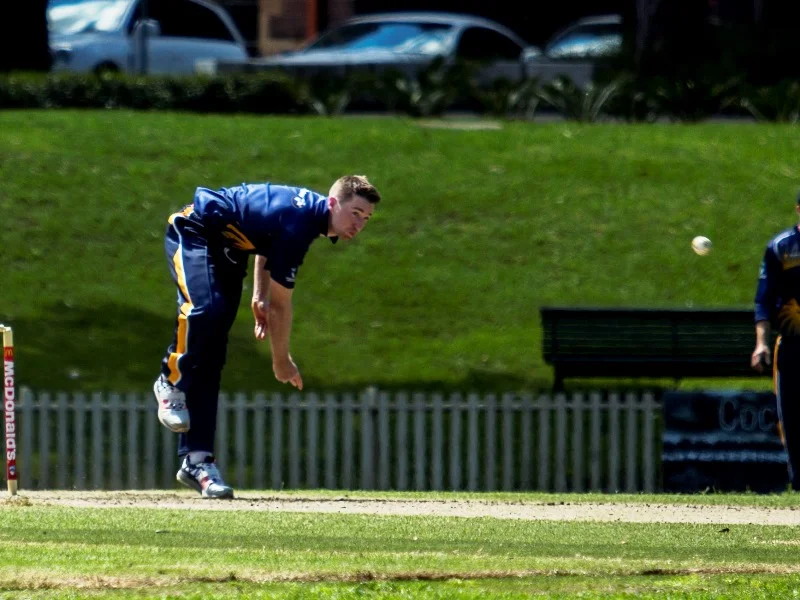
1s victory shining light in difficult weekend for students

1s victory shining light in difficult weekend for students

A resounding victory for Sydney Uni's first grade side was the only shining light in a difficult round against fellow Club Championship heavyweights, Manly-Warringah over the weekend.

FIRST GRADE:

A commanding first innings total is not always guaranteed with a win in the McDonald's NSW Premier Cricket competition, Easts chasing down Bankstown's 411 and Northern District falling 4 runs short of doing the same (though earning a draw) to Randwick-Petersham's 431 as examples, but Sydney Uni made sure of it with an outstanding display with the ball against Manly-Warringah at the Sydney Uni Cricket Ground (Uni No. 1).

A vicious opening spell from Tom Rogers (3-14 from 12) saw him claim the prized scalp of Adam Crosthwaite in the first over to leave Manly reeling and a long way from the target at 2-4. An 85-run partnership for the 2nd wicket steady the ship with Jay Lenton (56) top-scoring and Ryan Farrell (33) working hard to stay at the crease.

Sustained pressure from all of the bowling group saw quick wickets tumble during the middle session. A particularly fiery return spell from Rogers hurried Lenton, hitting him one ball and then producing a mistimed pull shot next ball. But it was the sublime leg-spinning performance from Devlin Malone (5-53 from 23 overs) that made light work of the victory. Often unplayable, Malone claimed the important wickets of James Crosthwaite and Ahillen Beadle before picking up three tail-enders for ducks.

Manly were eventually bowled out for 147 runs just before the tea break.

Sydney Uni sit in 3rd place (18 points) on the ladder as one four sides, Sutherland (19 points), Gordon (19 points) and Penrith (18 points), to open the season with three wins.

Uni take on Hawkesbury at Owen Earle Oval in Round 4.

DAY ONE HIGHLIGHTS
DAY TWO HIGHLIGHTS

SECOND GRADE:

Uni arrived at Mike Pawley oval for day 2 of the fixture against Manly with a big chase ahead of them following a tough day in the field on day 1. The in-form James Crowley came into the side as Ben Trevor-Jones moved up to replace Ryan Carters in 1st grade. Crowley showed excellent nash-ball keeping skills and another long distance strike from Will Hay was the match-defining moment in the olds win, again a man down. 

Manly declared before the start of play, leaving Uni to chase their overnight total of 324. On a good batting surface and fast outfield, the students were confident of batting through the day for a win, but a poor start saw us head into the first drinks 3/17. Ben Larkin and Nicky Craze went about restoring the innings and played well through to lunch before Craze fell soon after for 31, the score 4/80. Some vintage clips through mid wicket and cover drives among big sixes straight and over square highlighted Larkin's innings of 72. Larkin was ably supported by Crowley (26) seeing the students back on track until losing both accomplished batsmen in the 15 minutes before tea to leave the score 6/152. Hayden Kerr (34) and Dugald Holloway (29) demonstrated their all-round prowess with some hard hitting to provide some hope of victory late in the day, but it was too little too late as uni fell 92 runs short. 

Improvement to be made in all areas ahead of the next round match against the Hawks at the Sydney Uni Cricket Ground.

THIRD GRADE:

With only 166 runs on the board, Sydney Uni's bowlers were going to need to be disciplined early, Manly only requiring a further 60 runs with 8 wickets in hand at the start of play. 

Uni got a sense of a miracle when they claimed opener, Aiden Bariol, for 49 runs, but a patient 56-run 4th wicket partnership, lead to the inevitable Manly victory. Jack Holloway claimed 4 vital wickets, including 3 in an over, to ensure Manly could not stretch out in search of an outright. 

Manly eventually declared at tea at 7-239, with play called off at the tea break.

FOURTH GRADE:

Hopes were high for the 4s side after James Crowley steered the side to a strong total of 284.

Unfortunately though Manly batted well and the Uni attack struggled to breakthrough, with Manly passing the total in the 80th over with 4 wickets in hand.

Spinners Nick Powys (2-55 from 26 overs) and Ryan McElduff (2-84 from 22 overs) were the only multiple wicket takers for Uni.

FIFTH GRADE:

A below par batting effort on day 1 saw the 5s chasing their tail throughout the day as they tried to defend 213 runs at Camperdown Oval.

A batsmen friendly wicket saw the quicker bowlers blunted, and left spinners Connor Slater (3-66) and Zohirul Islam (2-43) as the only wicket-takers, Manly declaring at 5-233.

The Uni top-order negotiating the final 20 overs safely, finishing at 1-39 to ensure no further result.

METROPOLITAN CUP:

A disciplined batting effort was going to be needed from the young Metro Cup side to chase down Blacktown's commanding 4-294 (dec) and the side put in a determined effort, finishing all out for 202 from 93 overs with only 9 men. 

James Gillespie (61) scored his first half-century for the Club and combined for an 82-run opening partnership with Green Shield opener Ayush Mishra (29). Danny Wicks (44), Jono Phoebus (27) and Brad Osman-Kayani (22) helped push the total forward, but it was a dream too far in the end.

Blacktown decided to inflict punishment on the Uni bowler's by batting again to hit 2-111 from 13 overs in their 2nd innings before play was called to a halt. Green Shield leg-spinner, Shivansh Pathak, claimed 2-18 from his 3 overs, his first for the Club (and his first on turf).


Milestone Monday

Milestone Monday

Devlin Malone’s brilliantly sustained spell on Saturday – containing and threatening the middle order, demolishing the tail in a handful of deliveries – earned him 5-53, his best figures and first five wicket haul for the Club.  It was the third five-wicket haul of his First Grade career (including two for Sutherland).

Ryan Carters has passed 50 catches for the Club in First Grade.

Tom Rogers’ superbly hostile spell of 3-14 in First Grade was the best return of his short career with the Club to date.

Jack Holloway’s 4-50 against Manly was both his best bowling analysis in Third Grade and his best for the Club in any grade.

James Gillespie’s 61 against Blacktown in Metropolitan Cup was his first half-century for the Club.

Blues call up Carters

Blues call up Carters

University keeper/batsman Ryan Carters has been recalled to the NSW team for its Matador BBQs Cup match against Victoria at North Sydney Oval, starting tomorrow afternoon.

Carters has had limited opportunities with the bat for University this season, but has been in sparkling form, hitting 96 runs in three matches and being dismissed only once.  Unusually, his batting average of 96 is only the fourth-best in University's First Grade to date - he sits behind Nick Larkin (147.50), Greg Mail (138.00) and Ashton May (97.00).

Carters has withdrawn from the second day of University's Round 3 match with Manly-Warringah, and Ben Trevor-Jones takes his place behind the stumps.

Polished Cowan leads Blues chase

Polished Cowan leads Blues chase

Another classy half-century by University's Ed Cowan anchored NSW's chase of a modest Queensland total in last night's Matador Cup match at Drummoyne Oval.

The target of 173 wasn't a daunting one, but the pitch was slow and low, with some unpredictable bounce.  Cowan set the scoreboard moving with a crisp back-foot drive to the fence, and played several textbook straight drives down the ground.  His 51 came from only 69 deliveries, and when he was dismissed, NSW was well on course for the bonus-point victory clinched by Ben Rohrer's six in the 40th over.

Cowan has now top-scored for NSW in the last two Matador Cup matches.  This season, the better the bowling he's encountered, the better he's batted.

In The Sheds... The 'Fresher'

In The Sheds... The 'Fresher'

The seasonal cycle between footy in winter and cricket in summer is one that most of us have lived and grown to embrace for a majority of our lives. As one season passes, the next arrives in seemingly shorter fashion. Amidst the final few rounds of footy, the first cricketing email outlining schedules is sent, and with surprise, the response year after year is; ‘shit, already?!’ 

The dusty kit is pulled from the boot of the car and the forgotten last year's remnants of going-out-kit, unpaired socks, and stained whites, is belatedly emptied into the washing machine after spending many a month confined in the dark pit of sweaty pads and a stale helmet. My footy team is farewelled pre-September and the customary visit to the cricket store to top up stocks ensues. Leaving with a much lighter wallet, and with the car now used primarily as a second wardrobe loaded with cricketing gear and clothes, the sometimes daunted pre-season training is often the next stop. 

This year however, was a year of change. There was a distinct lack of pre-season emails received from now ‘ex’ coaches from previous seasons. Old team uniforms escaped the wash and were instead destined for the bin. Years’ worth of long worn tyre trails from A to B no longer existed and new paths were directed into the heart of Sydney’s Camperdown Campus. Unfamiliar faces replaced the old familiar names whose connections were now severed. The realisation of a long successful chapter closing, and a fresh one beginning, resurfaced familiar feelings of excitement this time accompanied with a strong sense of nervousness. Will I perform for the team? Will this new home be somewhere where my enjoyment for cricket (and a post-game change room beer) can thrive? All questions asked by nervous future debutants. The only familiarity being?... my footy team was still farewelled pre-September.           

Pre-season came and went. The wrath of ‘Broncos’ and extended hill sprints up Science Road were felt. Repeated bouncers from bowlers committing customary one meter no-balls in the ‘synthos’ were faced and dealt with. Full ‘straight one’s’ on middle were sometimes given the rusty-gate leave on middle peg. Round one arrived quickly thereafter and places were chosen in the change room. Certain spots were carefully avoided namely a five meter circumference surrounding Ed’s spot and Mailys’ corner.

One of the biggest learning curves encountered for a ‘fresher’ however, was the famous Nashball. After seeing fellow debutants from afar lay down a few drop-punts, important lessons were learnt before fully immersing one’s self in the Nash experience. Life lessons like: you can’t catch the ball below waist height, you can place the ball on the ground and it stops the game, and you can’t kick a ball whose sole purpose is for kicking, were pondered. With intense game-day Nash rivalry, never have I encountered a warm-up that does just that so well. So far, the top six have far outshone the bowlers with many a beer owed by the latter.  

The arrival at Sydney University Cricket Club was much like I expected it to be. State-of-the-art facilities, incredible support, and a world-class spectacle of a campus. Unexpectedly, the people and new team mates were more than accommodating and instead of feeling like an intruder, we were welcomed on equal grounds. Most notably, there was a unique aura of confidence and relaxedness, presumably a bi-product of positive attitudes’, self-driven motivation, and work-ethic. Importantly, I found that these values which seem to be deeply entrenched in my new teammate’s psyche are often practiced outside of cricket (whether it be intense study or highly demanding jobs) and will no doubt be an advantage for SUCC’ers on the field. This is something unique to SUCC that I haven’t observed in any other club, but something I find highly exciting and appealing in going forward.                     

Three rounds in, and after having had an amazing start so far by all, the excitement for the impending season is yet to be tarnished by three consecutive globes, or wearied by 96 overs in 40 degree heat watching some bloke block out a draw. The unaware self is also yet to experience the potential successes of premierships, hundreds, five-fa’s, or promotions for fellow team-mates. All are familiar processes that we have spent year in and year out gradually refining to make us all better people and players. How we deal and celebrate these ups and downs which are experienced by each individual and each team within our club is ultimately, what we play for. 

As the seasons keep on rolling in, I have looked forward to this one more than any in recent times. I also look forward to the new memories, successes and mateships that are, and have yet to be forged.    

Good luck to all for the season and I look forward to catching you around.

Remembering... HN MacLaurin

Remembering... HN MacLaurin

James Rodgers continues the series in which he commemorates the Sydney University cricketers who died serving in the First World War, a century ago.  Today: Henry Normand MacLaurin. 

Lt Colonel Henry Normand MacLaurin was born in Sydney on 31 October 1878 and killed at Gallipoli 27 April 1915.   He is remembered at Gallipoli by a landmark called ‘MacLaurin’s Hill’.

He was a highly successful barrister, active in the militia forces when he enlisted on 15 August 1914, almost as soon as war was declared.

TonyCunneen, who has done invaluable research into lawyers’ service in the Great War, has written about the NSW legal profession: ‘While they were certainly members of what the historian Manning Clark called the ‘comfortable classes’ they were also willing to forgo the security and safety of that class and give all their support to the cause of national identity and honour on the battle fields on the other side of the world.’

MacLaurin played only two seasons for Sydney University CC.  In 1896-97, after scoring only 44 runs at 7.3 in 2nd Grade, he was inexplicably promoted to 1st Grade (1st Grade cap number 53) where he played another two games without distinction. In the season when the Club was readmitted on humbling terms to the Grade Competition in 1898-99, MacLaurin was selected in 1st Grade  twice more. An energetic 54 was followed by a nondescript 5 and he played no more.

His father, Sir Henry Normand MacLaurin (1835-1914), a Scotsman, was Chancellor of the University of Sydney from 1896 until his death. He was also President of the Legislative Council, the Upper House of the NSW Parliament. A dominant figure in conservative politics, he was nevertheless admirably open to fresh educational ideas, especially those brought forward by the NSW Labor Government of 1910 which related to the reform of the Senate of the University. His second son, named after his father, was educated at Blair Lodge School at Polmont in Scotland and then at Sydney Grammar School. Two other sons, Charles and Hugh both served in the War.

After graduating BA in 1899 and admission to the NSW Bar,  MacLaurin carried on his work as a barrister from 11 Wentworth Chambers in Elizabeth St, specialising in accountancy. He also pursued a military career. Commissioned in the NSW Scottish Rifles in 1899, he eventually rose to command the 26th Infantry Regiment in July 1913. When he enlisted in the AIF, he was immediately appointed Lieutenant Colonel, commanding the 1st Infantry Brigade, a force of 4000 men. At 36 years of age, he was young for such responsibility but he wisely chose more experienced men to command battalions under him.

In a letter to  Justice David Ferguson (whose son, Arthur, a Law student who had also been to Sydney Grammar, was killed in France in 1916)  in March 1915, MacLaurin confided that rumours of the soldiers’ bad behaviour in Cairo had been exaggerated.  ‘With 20,000 men", he wrote,  'it can be easily seen that some would play up for a bit while their money lasted…’  He stood up for his men, attacking those civilians who were ‘doubtful and dissatisfied and critical’. Their accounts were ‘false and malicious’. Although he was a stern disciplinarian, he had a fine reputation among his men who respected his energy and enthusiasm especially when they trained under him in Egypt.

When orders for the landing at Gallipoli came through, MacLaurin was said to have ‘happily cancelled his leave and bounded smiling up the stairs to the General’s office to plan the attack.’ (Cunneen).

During the afternoon of 27 April 1915, at about 3.15 pm, MacLaurin ‘was standing on the slopes of the ridge that now bears his name… in the act of warning soldiers to keep under cover when he too was shot dead…MacLaurin was buried by his men where he fell.’ In 1919, he was reinterred at the 4th Battalion Parade Ground Cemetery. He was posthumously promoted to Brigadier General.

He was the fifth of the 337 from Sydney Grammar who were  killed or who died in the War. An extraordinary 2172 ‘Old Sydneians’ enlisted. (I am indebted to Dr Philip Creagh who has carried out painstaking and forensic analysis of the Old Sydneians who enlisted). There was widespread grief among the legal profession. A ceremonial service was held at the Banco court and special mention was made in the minutes of the Bar Association.

He was the first of the Club’s former players to be killed.

CEW Bean wrote of him:

           ‘…a man of lofty ideals, direct, determined, with a certain inherited Scottish dourness…but an educated man of action of the finest type that the Australian universities produce.’

You Might Not Remember... our largest opening partnership

You Might Not Remember... our largest opening partnership

The magnificent opening partnership of 337 between Nick Larkin and Greg Mail against Manly-Warringah last Saturday set a new record for Sydney University in the Sydney First Grade competition.   Statistically, it’s an imposing achievement – in the 123 years of the competition, there has only been one higher opening partnership, the 423 shared by the incomparable Victor Trumper (who hit 335 not out) and Dan Gee for Paddington against Redfern in February 1903.

Even so, the mark set by Mail and Larkin fell just short – by only eleven runs – of the highest opening partnership ever recorded for the University 1st XI.  That record – 348 – was set back in February 1889, four seasons before the establishment of what was then called “Electoral Cricket”, and is now NSW Premier Cricket. 

In 1889, there was no formal club competition in Sydney.  Instead, the “senior” clubs, as they were known, staged matches between themselves on an irregular basis.  The oldest of these clubs was Sydney University; the Albert Club was another.  It had once been a formidable club, virtually monopolising the cricketing talent of the colony, but by 1889 its strength had declined significantly.   University and Albert usually played each other a couple of times each season, and agreed to meet in a two-day match, on 16 and 23 February, on the “Association Ground” – better known today as the Sydney Cricket Ground.   The Referee thought that “the teams appeared to be rather equally matched”, even though Albert was without its wicket-keeper Syd Deane - a unique character who, after representing NSW in both cricket and Rugby, reacted to his omission from the 1890 Australian team by concentrating on his career in the theatre, before becoming the first Australian to act in Hollywood films.  Sydney University was led by Tom Garrett who, at the age of 31, was in his seventeenth season with the club.  He had earned his place in the very first Australian Test team as a fast-medium bowler but, as his prominence as a bowler declined, he had steadily improved his batting.  When Garrett won the toss, he had no hesitation in batting, and he walked out to open the innings himself when play began at 2.15pm.

His partner was Herbie Lee, 23, a nuggetty right-handed batsman who was far better known as a Rugby Union forward – he played for NSW seven times between 1884 and 1890.   According to one observer, “the bowling was fair enough for two or three overs, and then Garrett started making fourers in quick time.  The old University trundler was in fine fettle, and scored off nearly every ball”.  Frank Iredale, the future Test batsman, was called upon to do a good deal of the bowling – but his medium-pacers, which would dismiss only six batsmen in his 133 first-class matches, were not particularly threatening.  “Almost every man of the Alberts was tried with the ball”, reported the Evening News, “but the bowling throughout was very inferior.”  Before long, Garrett simply charged down the wicket to every delivery, connecting with some immensely powerful drives.  This tactic might have brought about his downfall, as twice he skied the ball into the outfield, but both chances were spilled.  On a third occasion, he hoisted the ball towards long-on, where the fieldsman, Joe Rowley, lost his footing as he ran in for the catch, fell flat on his back, and could only watch the ball sail over his head and into the fence.  Garrett made no mistake with the next ball, which he deposited into the Ladies’ Stand – a hit which was then worth only five runs.

At two minutes to six, Garrett and Lee had been batting for 193 minutes, and the score stood at 348.  Lee, who had 123 to his name, played back quietly to a delivery from Tasman Deane, only to see the ball hit the ground and spin back onto his stumps.  There was no time for the new batsman to take his place at the crease, and so stumps were drawn with Garrett unbeaten on 220.  The partnership was acclaimed as the highest for any wicket in senior club cricket in Sydney.

What followed on the second day of the game verged on farce.  If the match had been played today, University would probably have declared its innings closed at the end of the first day, 348 being more than enough runs to win the game.  But the Laws of Cricket did not, in 1889, permit a team to declare its innings closed, so University had no choice but to carry on batting.  The new batsman, Test player Reginald Allen, missed a straight ball and was anti-climactically bowled for 0.  But Garrett carried on cheerfully, whacking the ball around the ground until, on 274, he edged it to the solitary slip fieldsman.  His innings remains the highest ever recorded for the University 1st XI.  George Barbour, a Sydney Grammar schoolmaster and NSW Rugby representative, then scored his second century for University, and the veteran Theo Powell (who had played for NSW as early as 1871) thrashed out a furious 53, until eventually the last wicket fell with the total on 635.  But it was five minutes to six – too late for the Albert innings to begin.  The game was drawn, with Albert fielding throughout the entire match.

Twelve months later, the Laws of Cricket were altered to allow an innings to be declared closed.  The first recorded declaration was made in an English county match between Nottinghamshire and Kent in 1890.   That change undoubtedly improved the game: it also means that Tom Garrett’s record innings of 274, and the University total of 635, are unlikely to be surpassed.